“How many gas stations are there in the United States?” If that question makes you freeze, you are not alone. Market sizing questions feel impossible the first time. You have no data, no context, and about three minutes to produce a credible number.
But that is exactly the point. Consulting firms use these questions to evaluate how you handle ambiguity. They do not care whether your answer is within 5% of the real number. They care about whether your approach is logical, structured, and defensible.
The Two Main Approaches
Every market sizing problem can be attacked from the top down or the bottom up. Choosing the right approach is your first decision, and it matters.
Top-Down (Demand Side)
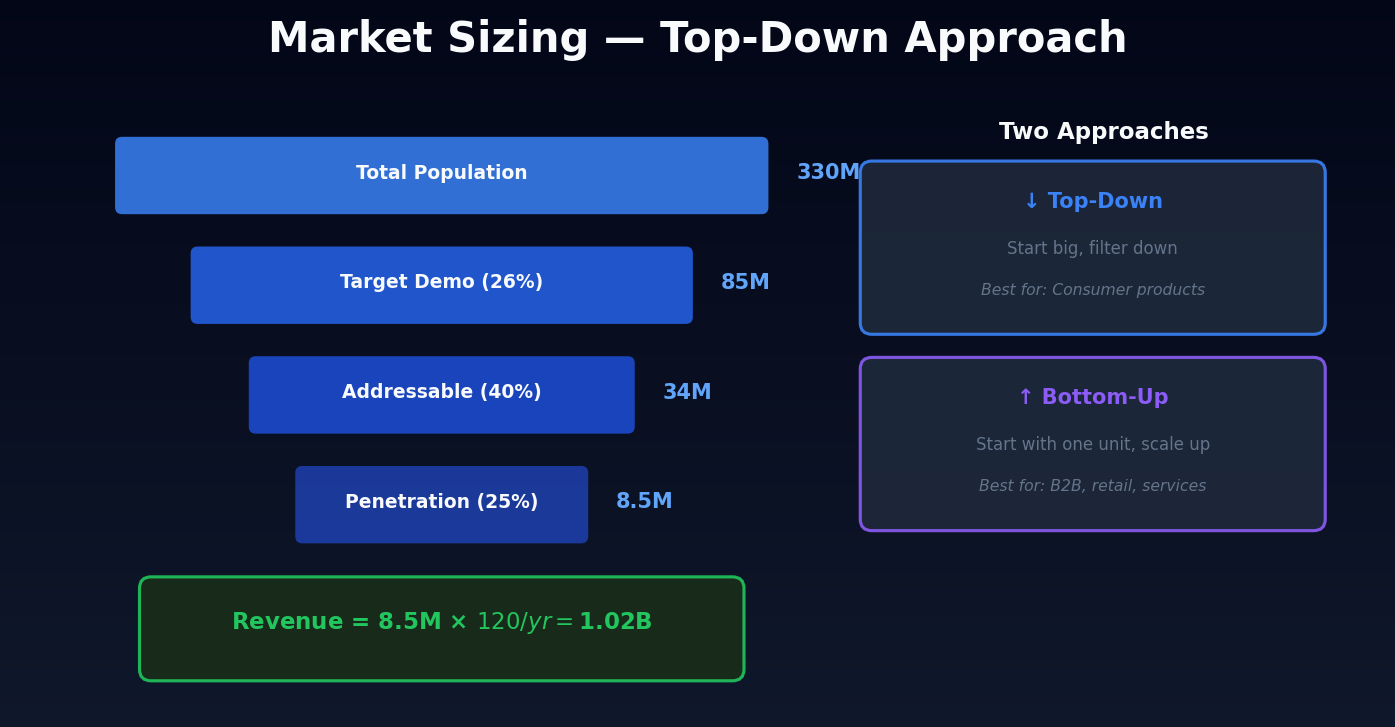
Start with a large, known number – usually a population – and narrow it down through a series of logical filters.
Best for: Consumer products, services used by individuals, anything where you can segment a population.
Example: How many yoga mats are sold in the US each year?
Start with the US population (~330 million). Estimate the percentage who practice yoga (~10%, or 33 million). Estimate how often they replace a mat (every 3 years on average). Annual demand = 33 million / 3 = ~11 million mats. Then add first-time buyers: if yoga is growing at ~5% per year, that is another 1.5 million new practitioners buying their first mat. Total estimate: ~12-13 million mats per year.
Bottom-Up (Supply Side)
Start with a single unit – one store, one location, one provider – and scale it up to the total market.
Best for: Retail, restaurants, services with physical locations, B2B markets where you can count providers.
Example: What is the annual revenue of the US car wash industry? Start with one car wash: 100 cars per day at $15 per wash = $550,000 per year. Estimate ~50,000 car washes in the US. Multiply: 50,000 x $550,000 = ~$27.5 billion.
The Step-by-Step Process
Regardless of which approach you choose, follow this process:
Step 1: Clarify the Question
Before you touch a number, make sure you know exactly what you are estimating. “How big is the coffee market?” could mean retail coffee sales, coffee shop revenue, total beans consumed, or global versus US. Ask the interviewer to specify the scope, the geography, and the metric (units, revenue, or something else).
Step 2: Choose Your Approach and State It
Tell the interviewer which approach you are taking and why: “I’m going to take a top-down approach starting with the US population, since this is a consumer product.” This small step makes a big impression.
Step 3: Build Your Framework on Paper
Before computing anything, lay out the full chain of logic:
- Total population
- Filter: % in target demographic
- Filter: % who are customers
- Usage frequency
- Price per unit
This gives the interviewer a roadmap and gives you a structure to follow. It also makes it easy to adjust individual assumptions later without redoing the whole calculation.
Step 4: State and Justify Each Assumption
This is where candidates differentiate themselves. Do not just say “I’ll assume 20% of people drink coffee.” Say why: “I’ll assume about 60% of US adults drink coffee at least occasionally – I’ve seen that figure cited, and it feels reasonable given how prevalent coffee shops are. Of those, maybe a third drink it daily from a coffee shop rather than at home, so roughly 20% of adults are daily coffee shop customers.”
You do not need to be right. You need to be reasonable and transparent.
Step 5: Compute Cleanly
Do the arithmetic step by step. Round aggressively – this is an estimation, not an accounting exercise. Talk through your math out loud so the interviewer can follow. If you need a refresher on mental math techniques, our guide to case interview math without a calculator covers the key shortcuts.
Step 6: Sanity-Check Your Answer
This step is non-negotiable. After arriving at your number, gut-check it against anything you know. “I estimated $27 billion for the US car wash industry. That’s about $80 per person per year, which feels reasonable – maybe one or two car washes a month for car owners. I’m comfortable with this estimate.”
If the sanity check reveals something absurd – “that implies every American buys 40 yoga mats a year” – go back and find the broken assumption. Catching your own errors is a strong positive signal.
Worked Example: How Many Dentists Are in the US?
Let me walk through a complete example using the top-down approach.
Clarification: We are counting practicing dentists in the US (not retired, not dental hygienists).
Framework: - US population: ~330 million - How often does the average person see a dentist? Roughly twice per year for checkups, though not everyone goes. Let’s say 65% of the population visits a dentist at least once a year, so ~215 million dental visits per year. - Visits per year: 215 million people x 1.8 visits per year on average (some go twice, some once) = ~390 million visits. - How many patients can one dentist see per day? About 10-12 patients, call it 10 to keep it clean. - Working days per year: ~250 days, minus vacation and holidays, call it 220. - Patients per dentist per year: 10 x 220 = 2,200. - Total dentists needed: 390 million / 2,200 = ~177,000.
Sanity check: The real number is approximately 200,000. Our estimate of 177,000 is within 12% – a strong result for a three-minute estimation.
Mistakes That Cost Candidates Points
Jumping to math without a framework. If you start multiplying numbers before laying out your logic, you will almost certainly miss a step or double-count something. Framework first, math second.
Using overly precise numbers. Saying “I’ll assume 17.3% of the population…” does not make you look smart. It makes you look like you are guessing with false precision. Use round numbers: 15%, 20%, one-third.
Not stating assumptions explicitly. If the interviewer does not know what you assumed, they cannot evaluate your logic. Every assumption should be said out loud.
Skipping the sanity check. A missing sanity check tells the interviewer you do not have the habit of questioning your own work. Always close with a reasonableness test.
What Caise Tests in Market Sizing Cases
Most practice tools let you check whether your final number is close. That misses the point. The interviewer does not score your answer – they score your process. Caise’s AI interviewer evaluates market sizing cases the same way an MBB interviewer would, across five scored dimensions.
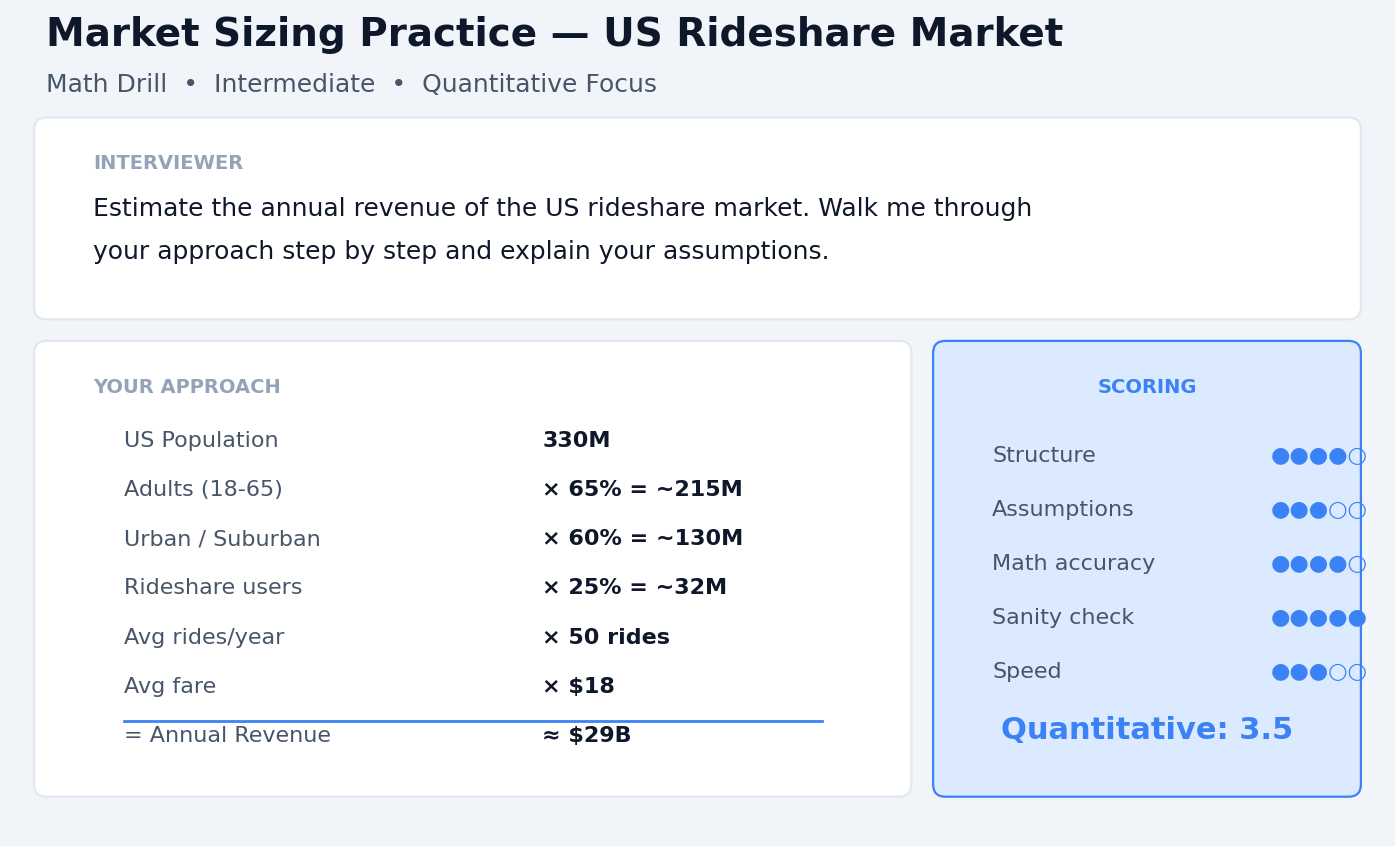
Quantitative (scored 1-5). This is the big one for estimation questions. Caise evaluates whether you decompose the problem into a clear formula before computing anything. It checks that you structure calculations top-to-bottom rather than jumping between steps, that you round sensibly, and that you sanity-check your final number. If you arrive at a reasonable answer but got there through a disorganized chain of arithmetic, your Quantitative score will reflect that.
Structuring (scored 1-5). Did you choose the right approach for this problem? A top-down approach for a consumer product question is strong. A bottom-up approach for the same question might still work but requires more assumptions – and Caise will note whether you justified that choice. The Structuring score captures how deliberately you set up the problem before touching any numbers.
Communication (scored 1-5). Every assumption you make should be stated out loud and justified. Caise tracks whether you articulate each assumption before using it in a calculation, or whether you quietly plug in numbers without context. In a real interview, an unstated assumption is an invisible assumption – the interviewer cannot give you credit for reasoning they cannot see.
Socratic pushback in real time. This is where Caise diverges from static practice. When you state an assumption – say, “I’ll estimate 30% of Americans own a car” – Caise will challenge weak logic the way a real interviewer would: “That seems low. What are you basing that on?” or “How would your answer change if that number were 50%?” If you cannot defend your assumptions under pressure, you will struggle in the live interview. Caise forces you to build that muscle.
Handouts and exhibits mid-case. Some market sizing questions are not pure estimation. The interviewer hands you a data table or chart partway through and expects you to integrate real numbers into your framework. Caise replicates this by surfacing interactive handouts during the case – a population breakdown by age group, an industry revenue table, or a pricing survey. You need to adjust your assumptions on the fly based on actual data, just as you would in a real case.
After each case, Caise provides MBB exemplar responses showing exactly how a top candidate at McKinsey, BCG, or Bain would have answered the same question – including their framework choice, assumption justifications, and sanity checks. Comparing your approach against the exemplar is where the real learning happens.
How to Build This Skill
Market sizing is one of the most practicable case interview skills because you can drill it anywhere. Pick any everyday business and estimate its market size while commuting or waiting in line. The more reps you do, the faster your intuition develops.
When you are ready to simulate the real interview experience, Caise scores every market sizing case across five dimensions – Structuring, Analytical, Quantitative, Communication, and Synthesis – each rated 1-5. Its AI interviewer challenges your assumptions in real time with Socratic pushback (“Why did you assume 20%? What evidence supports that?”), and after each case you get MBB exemplar responses showing exactly how a top candidate would have structured and defended the same estimation. That feedback loop – seeing the gap between your answer and the exemplar – is what turns repetition into actual improvement.
For the broader case interview toolkit, pair this with our guides on structuring frameworks and profitability cases to cover the most common question types you will face.