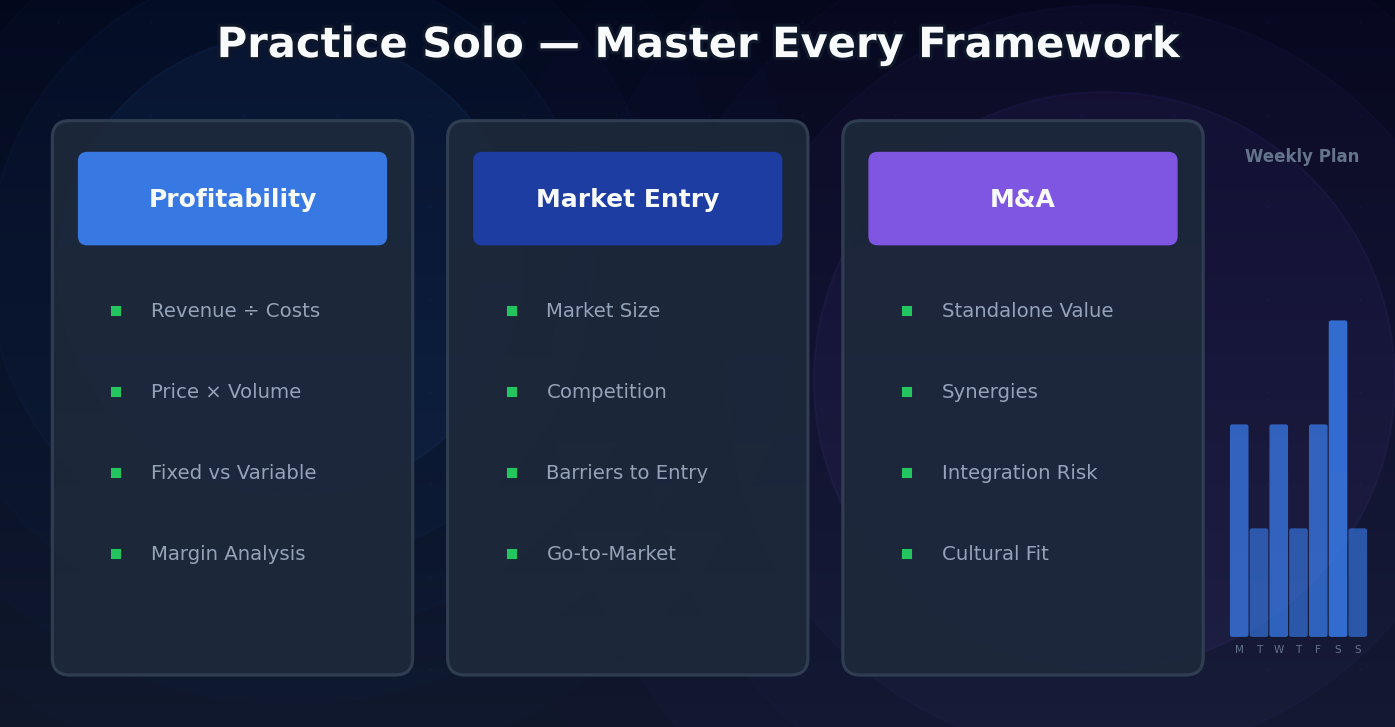
The standard advice for case interview preparation is: find a practice partner and do mock cases together. It is good advice. The problem is that it assumes you have access to someone who is available, competent, and willing to invest hours of their time practicing with you. Many candidates – especially those outside of target MBA programs or switching careers from non-consulting industries – do not have that luxury.
The good news is that solo practice, done correctly, can be highly effective. Some aspects of case preparation are actually better suited to individual work. The key is knowing which skills to drill alone and how to simulate the interactive elements you would normally get from a partner.
What You Can (and Cannot) Practice Alone
Let me be direct about the tradeoffs. There are parts of the case interview that are straightforward to practice solo, and there are parts that are harder without a human or AI counterpart.
Excellent for solo practice: - Mental math speed and accuracy - Framework building and structuring - Market sizing estimations - Business intuition and industry knowledge - Reading and interpreting charts and data
Harder to practice alone (but not impossible): - Verbal communication and synthesis - Responding to interviewer pushback - Managing the back-and-forth dialogue flow - Calibrating your pacing and timing
The goal of a good solo practice routine is to cover the first category thoroughly and find creative ways to approximate the second.
Solo Drill 1: The Daily Math Workout
Mental math is the most individual skill in case interviews, and it responds directly to repetition. You do not need a partner for this – you need discipline.
The routine (15 minutes per day):
Spend five minutes on multiplication drills: two-digit by two-digit numbers. Write 10 problems on a sheet of paper, set a timer, and solve them. Check your answers. Track your speed over days and weeks.
Spend five minutes on percentage calculations: “What is 35% of 8,000?” “If something grows from 120 to 156, what is the percentage increase?” These come up in virtually every case.
Spend five minutes on division: “4,500 divided by 70.” “27 million divided by 1,300.” Focus on getting to approximate answers quickly rather than exact ones.
If you want detailed techniques for these calculations, our mental math guide covers the core shortcuts.
Solo Drill 2: One-Page Structuring
This drill builds the most critical case interview skill: turning an ambiguous prompt into a clear, MECE framework.
The routine (20 minutes, 3-4 times per week):
Get a case prompt from any case book, website, or collection. Read only the opening paragraph – the setup. Do not read the solution or any interviewer guidance.
Set a two-minute timer. In those two minutes, build a framework on paper: the three or four key areas you would investigate, with two or three sub-points under each. Write it as a structured outline, not a paragraph.
When the timer stops, evaluate your framework against these criteria: - Is it MECE? Do the buckets overlap? Did you miss an obvious area? - Is it tailored? Does it reflect the specifics of this company and industry, or could it apply to literally any case? (If the latter, it is too generic.) - Is it prioritized? Which bucket would you start with, and why?
Then read the solution to see how the case actually plays out. Note which of your buckets were relevant and which were not. Over time, you will develop an instinct for what matters.
For a deeper dive into structuring methodology, see our complete framework guide.
Solo Drill 3: Market Sizing Reps
Market sizing questions are perfectly suited to solo practice because they are self-contained. There is no interviewer feeding you data – you generate all the assumptions yourself.
The routine (one estimation per day):
Pick a question. Good sources include lists of common market sizing questions from consulting prep sites, or simply look around you and ask: “How many of these exist? What is this market worth?”
Work through the estimation on paper using the step-by-step framework from our market sizing guide. State each assumption out loud – yes, out loud, even when you are alone. This builds the verbal habit you will need in the real interview.
After you finish, Google the actual answer (if available) and compare. The goal is not to be exact but to be within a reasonable range. If you are consistently off by more than 3x, your assumptions need calibration.
Solo Drill 4: Talking Out Loud (Seriously)
One of the biggest gaps in solo prep is the verbal component. Many candidates can think through a case on paper but stumble when articulating their thinking out loud.
The routine: After completing a structuring or market sizing drill, present your answer out loud as if the interviewer were in the room. Time yourself – you should deliver a framework in 60 to 90 seconds and a market sizing in three minutes. Record yourself and listen back for filler words, long pauses, and tangled logic.
The Missing Piece: Simulated Pushback
The hardest thing to replicate alone is the interviewer pushing back on your assumptions, redirecting your analysis, or asking a probing follow-up question. In a real case, this dialogue is constant – the interviewer is an active participant, not a passive listener.
This is where solo preparation has a genuine limitation. You can partially address it by playing devil’s advocate with yourself after each assumption, or by using case books that script the full interviewer dialogue (reading each prompt aloud before responding). But neither approach truly replicates the unpredictable, adaptive pressure of a real interviewer. That is the problem Caise was built to solve.
How Caise Closes the Gap
Caise conducts full voice-based case interviews. You speak your answers out loud – just like you would in a McKinsey office – and the AI interviewer responds in real time. This is not typing into a chat box. You are building the exact verbal fluency and pacing that candidates struggle to develop alone.
The AI uses the Socratic method throughout the case. If you propose a framework, it might ask “Why did you choose that approach over alternatives?” If you state an assumption without grounding it, it will challenge you: “What is that assumption based on?” If your logic has a gap, it will press on it rather than let you move on. This is the kind of pushback that makes partner practice valuable – except it is available at any hour, with no scheduling required.
Mid-case, when you ask the right clarifying questions or request data, Caise shares interactive exhibits and handouts – charts, tables, financial data – just like a real interviewer who has a packet of exhibits in a folder and hands them over when you demonstrate the right analytical instincts. You learn not just to analyze data, but to proactively ask for it.
After the case ends, you receive a detailed scorecard across all five dimensions that consulting firms evaluate: Structuring, Analytical Ability, Quantitative Skills, Communication, and Synthesis. Each dimension is scored on a 1-to-5 scale with specific, actionable feedback explaining what you did well and where you fell short.
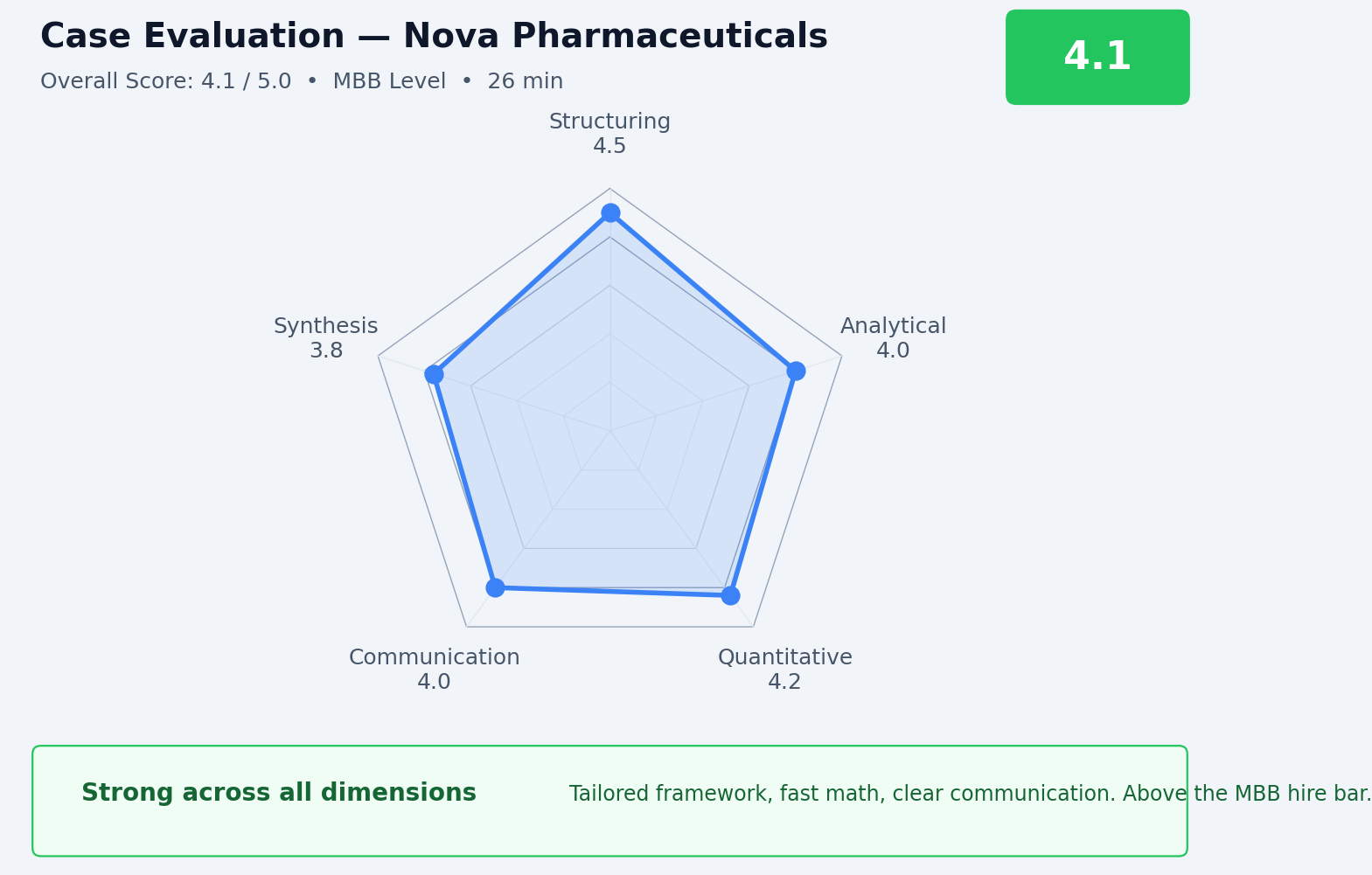
One of the most valuable features is the MBB Exemplar. At your weakest moments in the case – the places where you stumbled or gave a mediocre answer – Caise shows you exactly what a Distinctive-rated candidate would have said. This is not generic advice. It is a concrete, case-specific response that demonstrates the level of precision and insight top performers bring.
After reviewing your scores, you can enter a post-case debrief where you ask the AI coach follow-up questions about your performance. “Why was my synthesis weak in this case?” “How should I have structured that profitability question differently?” “What data should I have asked for earlier?” The debrief turns a single case into a deeper learning opportunity.
Over time, Caise tracks your scores across every case you complete. You can see your progression on each of the five dimensions, identify persistent weak spots, and focus your practice where it matters most. The coaching insights feature also surfaces recurring patterns across all your cases – things like “you consistently underweight competitive dynamics in your frameworks” – that are nearly impossible to identify on your own.
Building a Weekly Solo Practice Schedule
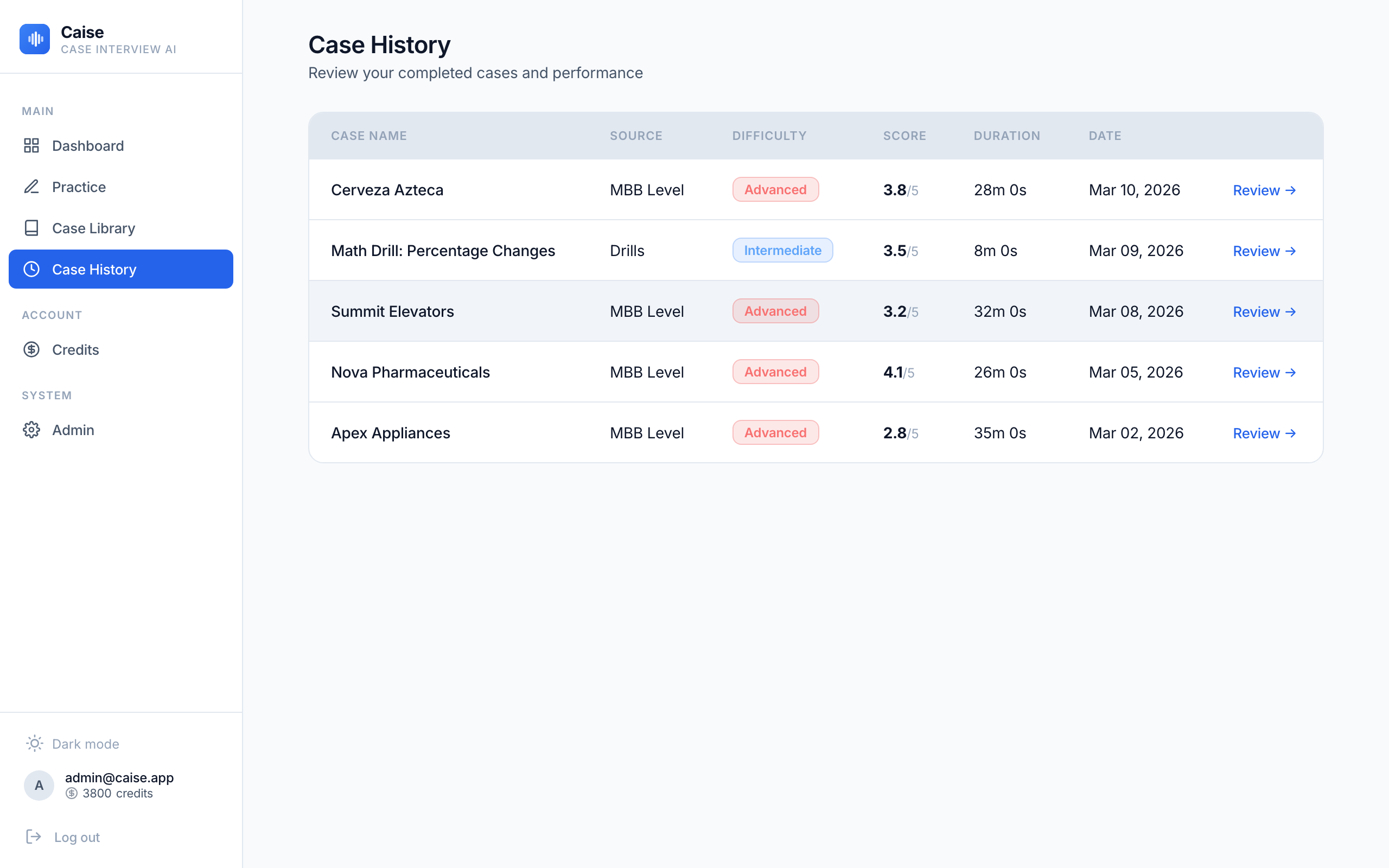
Here is a realistic weekly plan that covers all the key skills:
Monday through Friday: - 15 minutes: math drills (daily, non-negotiable) - 20 minutes: one structuring drill (4x per week) - 15 minutes: one market sizing estimation (3x per week)
Weekends: - 45 minutes: one full self-led case (read the prompt, structure, work through each section, present your recommendation out loud) - 15 minutes: chart interpretation drill (2x per week)
For the daily math portion, Caise’s math drills are a strong option. There are 10 timed drills covering the exact calculation types that appear in real cases – percentage changes, breakeven analysis, weighted averages, and more. They give you structured reps with immediate feedback, which is more efficient than generating your own problem sets from scratch.
This adds up to roughly 3 to 4 hours per week of focused practice. Maintain this for 4 to 6 weeks and you will see substantial improvement across all dimensions.
When to Supplement With Partner Practice
Solo practice is a strong foundation, but if you can get a few partner sessions in, save them for the later stages – after you have built your math speed, structuring instincts, and verbal fluency. You will get far more value from a partner session when you already have the basics down.
The bottom line: do not let the absence of a practice partner become an excuse to delay. The candidates who outperform start early, practice consistently, and use every tool available – including the time they have alone.