The moment an interviewer slides a chart across the table and asks “so what does that imply for the unit margin?” your math skills are on display. There is no calculator. There is no spreadsheet. There is just you, a pen, and whatever arithmetic you can do in your head or scratch out on paper in real time.
This terrifies a lot of candidates, especially those who have spent years relying on Excel. But here is the thing: case interview math is not hard math. You will never need calculus. You will rarely need anything beyond multiplication, division, percentages, and basic estimation. What you need is speed and confidence with simple operations under pressure.
Why Firms Test Mental Math
Consulting firms are not trying to find human calculators. They are testing three things at once: Can you set up the right calculation? Can you execute it without freezing? And can you interpret the result in a business context? A candidate who computes a rough answer quickly and then says “so that’s roughly a 15% margin, which is below industry average” is far more impressive than someone who spends three minutes getting an exact figure and then has nothing to say about it.
Speed matters because real client meetings move fast. Partners need analysts who can sanity-check numbers on the fly during a workshop, not after a two-hour modeling session.
The Core Techniques
Rounding Aggressively (Then Adjusting)
This is the single most important mental math habit. You are not taking a math exam – you are building a business argument. Round numbers to make them workable, then note the direction of your rounding so you can adjust your conclusion.
For example, if the interviewer says revenue is $487 million and there are 312 stores, you should immediately think: “$500 million divided by 300 stores gives me roughly $1.67 million per store.” That took two seconds. The exact answer is $1.56 million. You are off by about 7%, which is completely fine for a case interview. If the interviewer wants precision, they will tell you.
Rule of thumb: Round to the nearest “friendly” number – multiples of 5, 10, 25, or 100. Always round in the direction that makes the math easier.
Breaking Multiplications Into Pieces
Large multiplications become easy when you decompose them. The key insight is that multiplication distributes over addition.
Say you need to calculate 43 x 70. Think of it as (40 x 70) + (3 x 70) = 2,800 + 210 = 3,010. This takes a few seconds on paper and is nearly impossible to get wrong.
For even larger numbers: 2,400 x 350. Rewrite as 24 x 35 x 1,000. Then 24 x 35 = (24 x 30) + (24 x 5) = 720 + 120 = 840. So the answer is 840,000.
The Division Shortcut: Flip to Fractions
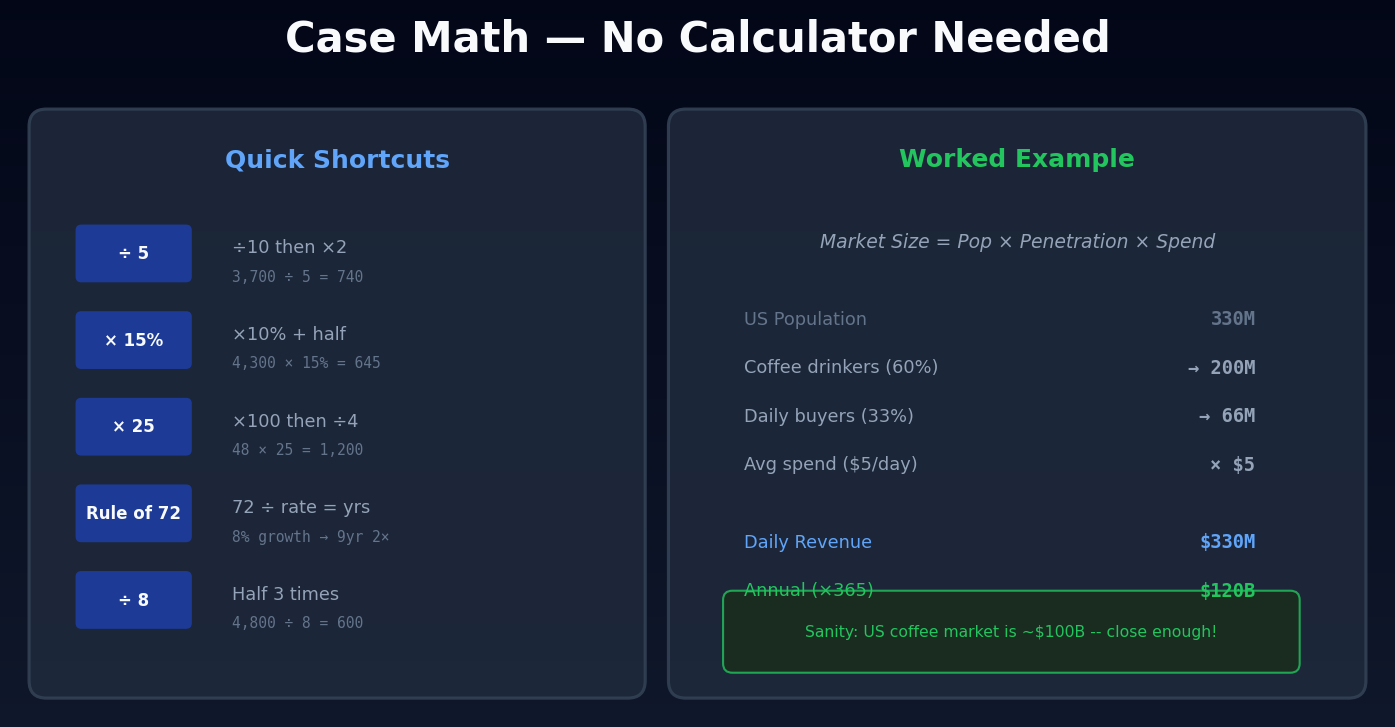
Division is where most candidates slow down. The trick is to convert divisions into multiplications using common fractions you have memorized. The key ones: dividing by 4 means halving twice, dividing by 5 means dividing by 10 then doubling, and dividing by 8 means halving three times.
The divide-by-5 shortcut is especially powerful. If you need 3,700 / 5, just compute 3,700 / 10 = 370, then double it: 740.
Percentage Calculations
Percentages come up constantly in case interviews – margins, growth rates, market share. Here are the fast paths:
- 10% of anything: Move the decimal one place left. 10% of 4,300 = 430.
- 5% of anything: Take 10% and halve it. 5% of 4,300 = 215.
- 15%: Take 10% and add half of it. 15% of 4,300 = 430 + 215 = 645.
- 20%: Take 10% and double it. Or divide by 5.
- 33%: Divide by 3.
- 1%: Move the decimal two places left. Then multiply for any small percentage.
For compound growth, do not attempt the formula in your head. Use the Rule of 72 instead: divide 72 by the growth rate to estimate how many years it takes to double. A market growing at 8% per year will roughly double in 9 years (72 / 8 = 9). This is good enough for most case contexts.
Dealing With Large Numbers: Use “Millions” and “Thousands” as Units
A common mistake is writing out all the zeros and then losing track. Instead, carry the units in your head. If revenue is $4.2 billion and costs are $3.8 billion, just compute 4.2 - 3.8 = 0.4 billion = $400 million profit. You never need to write nine zeros.
When multiplying, track the scale separately: “200 thousand times 15 thousand equals 200 x 15 = 3,000 … in units of thousand-thousands, which is millions. So $3 billion.” Keeping scale and arithmetic separate prevents errors.
Common Pitfalls to Avoid
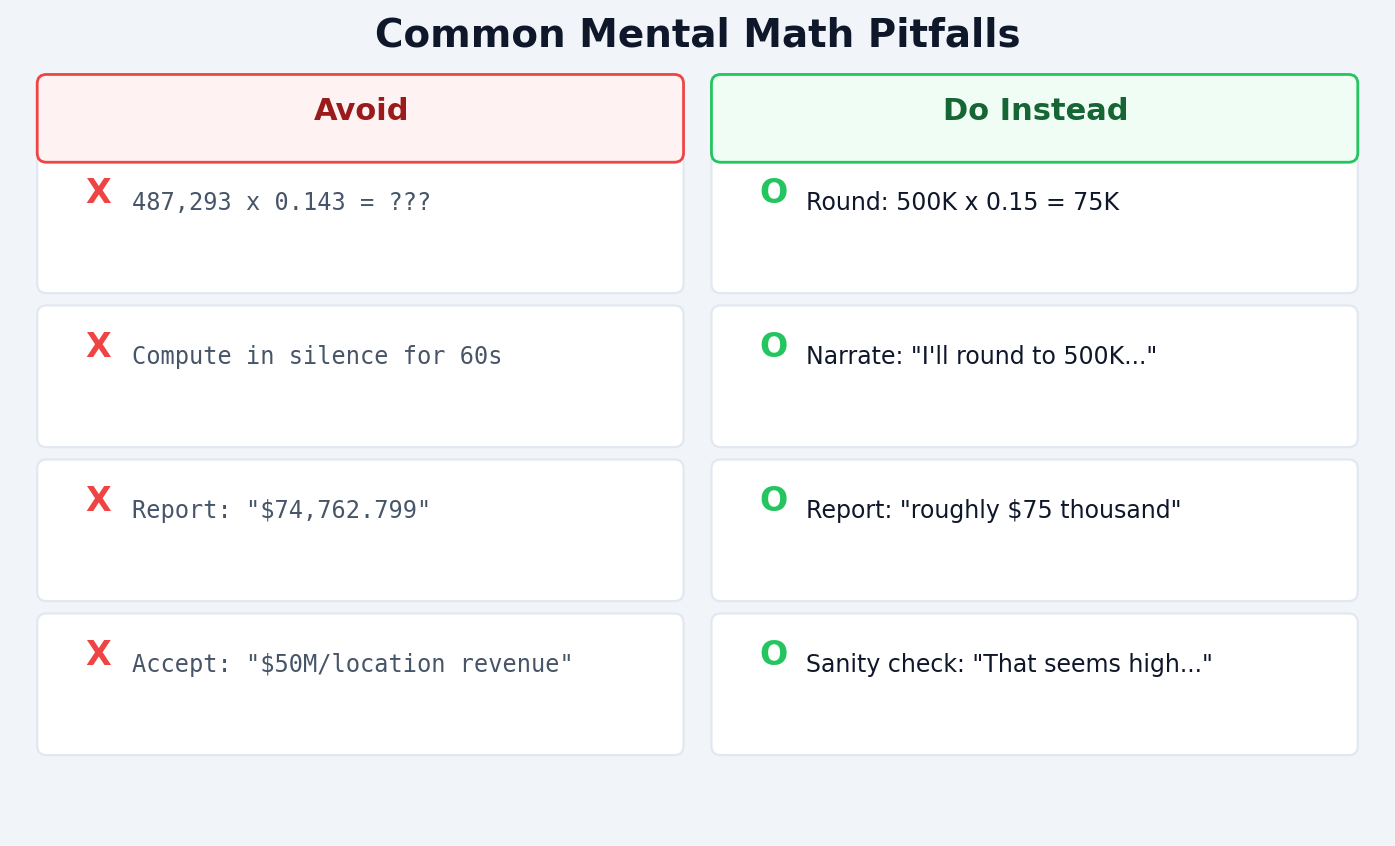
Writing too many digits. If you find yourself computing 487,293 x 0.143, you have already gone wrong. Round first, then compute.
Going silent. The interviewer cannot see inside your head. Talk through your math out loud: “So I need revenue per customer. I’ll round $12 million to $12 million since it’s already clean, and divide by 400 customers – that gives me $30,000 per customer.” This builds trust even if you make a small arithmetic error.
Not sanity-checking the result. After every computation, pause for one second and ask yourself: does this make sense? If you calculate that a fast-food restaurant generates $50 million in annual revenue per location, something went wrong. Developing business intuition for “reasonable” numbers is just as important as the arithmetic itself.
Panicking over errors. If you catch a mistake, correct it calmly. Interviewers respect self-correction. What kills you is confidently presenting a wrong number and building your entire argument on it.
How to Practice
Mental math is a muscle. You cannot read about it and expect to perform – you need repetitions. Here are three practice methods:
- Daily estimation drills. Pick any real-world question – “How many cups of coffee does this Starbucks sell per day?” – and force yourself to estimate it using round numbers within 60 seconds.
- Flashcard-style arithmetic. Practice multiplying two-digit numbers, dividing by common denominators, and computing percentages. Even 10 minutes a day for two weeks makes a noticeable difference.
- Full case practice with a timer. The only way to get comfortable doing math under interview pressure is to simulate that pressure. Practicing cases with Caise is particularly effective here because the AI interviewer presents quantitative problems in real time and will not let you move on until you work through the numbers. Caise scores your Quantitative dimension on a 1-to-5 scale after every case, so you get specific feedback on your math speed, accuracy, and how well you interpreted the result – not just whether you got the right answer. With 60+ cases from HBS, Bain, MBB-level sources, and Caise Originals, there is no shortage of quantitative problems to work through.
If you are also working on your structuring skills, take a look at our framework guide – strong structure and strong math together are what separate top candidates from the rest.
How Caise Tests Your Math Skills
Everything in this article – rounding, decomposition, percentage shortcuts, sanity-checking – only matters if you can execute it under pressure while talking to another person. That is a fundamentally different skill from solving problems on paper in a quiet room. Caise is built around this reality.
The Quantitative Dimension: Scored 1 to 5
After every case, Caise evaluates your performance across five dimensions: Structuring, Analytical Ability, Quantitative Skills, Communication, and Synthesis. Each is scored on a 1-to-5 scale, where a 3 represents the MBB hire bar (adequate performance), a 4 is strong, and a 5 is Distinctive – the top tier that earns offers at McKinsey, BCG, and Bain.
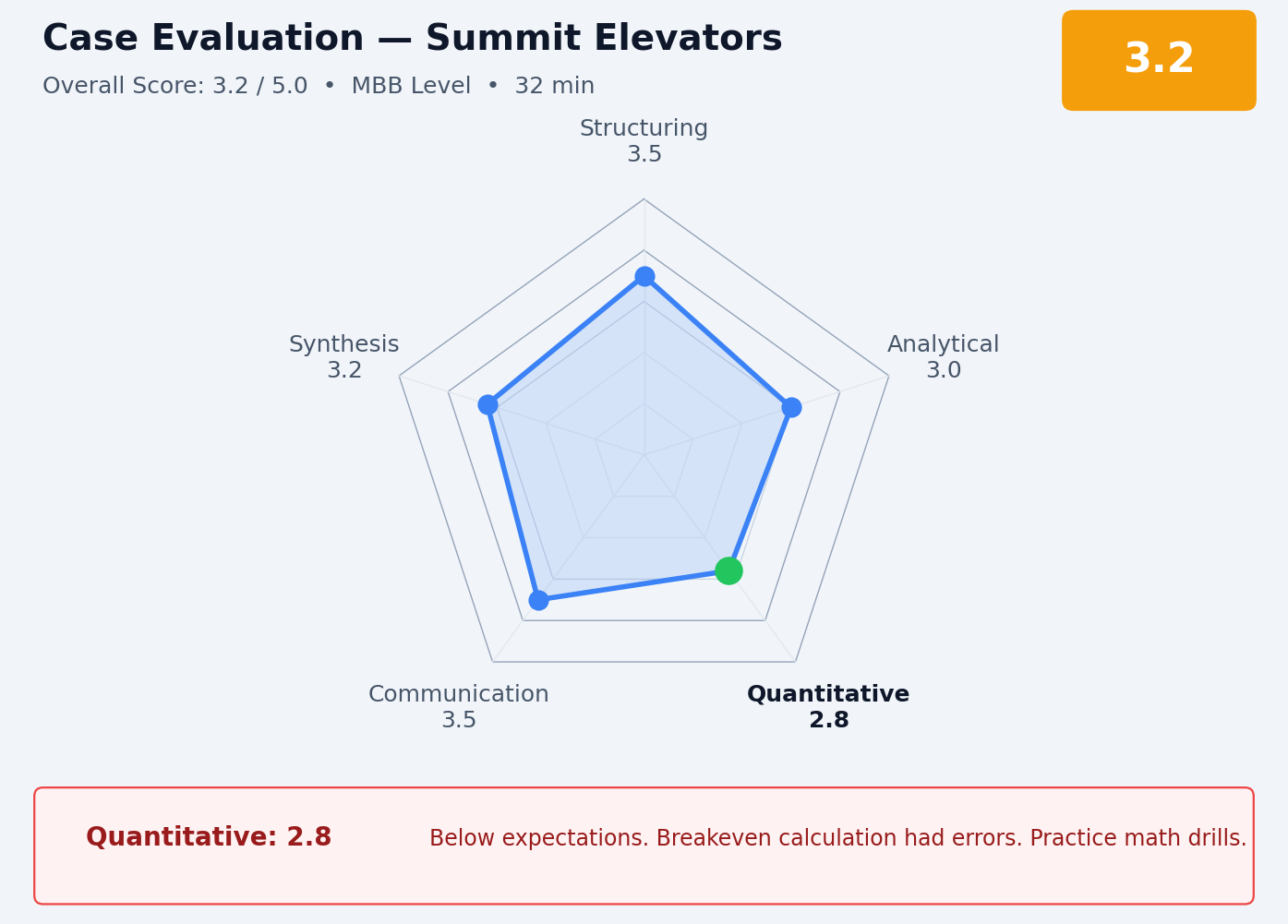
The Quantitative dimension specifically evaluates four things: how quickly you set up and execute calculations, whether you structure your math in a logical sequence, how effectively you round and simplify without sacrificing accuracy, and whether you sanity-check your results before moving on. A candidate who computes quickly but presents a nonsensical answer will score lower than one who takes an extra few seconds to verify the result makes business sense.
This scoring is not a vague “good job with the math” – it pinpoints exactly where your quantitative performance broke down and what a stronger candidate would have done differently.
10 Math Drills for Targeted Practice
Caise includes 10 dedicated math drills that isolate the exact calculation types you will face in real cases. These cover percentage changes (both forward and reverse – “revenue grew 12%” is different from “what growth rate gets us from $340M to $400M?”), breakeven analysis, weighted averages, and market sizing calculations. Each drill is timed, giving you structured repetitions with immediate feedback on both speed and accuracy.
The drills are designed to build the kind of automaticity described earlier in this article. When computing 15% of $4,300 becomes reflexive rather than effortful, you free up mental bandwidth for the harder part: interpreting the number and connecting it to the business problem. Ten minutes of math drills a day, consistently, produces measurable improvement within two weeks.
Voice-Based Practice: Math Out Loud
Here is a challenge most candidates underestimate: doing math while talking. In a real interview, you cannot go silent for 45 seconds while you compute. You need to narrate your approach – “I am going to round revenue to $500 million and divide by 300 stores, which gives me roughly $1.7 million per store” – while simultaneously doing the arithmetic.
Caise’s interviews are entirely voice-based. You speak your answers out loud, and the AI responds in real time. This forces you to build the specific skill of articulating your math as you do it, which is a distinct capability from writing calculations on a sheet of paper. Candidates who practice this way consistently report that their real interviews feel easier because the verbal math habit is already built.
Socratic Pushback on Your Numbers
One of the most valuable aspects of Caise’s AI interviewer is that it does not passively accept your calculations. If you produce a number that seems off, the interviewer will push back: “That number seems high – can you walk me through your calculation?” If you round too aggressively without noting it, you will hear about it. If you skip a sanity check and present an answer that implies a coffee shop generates $50 million per year, the AI will flag it.
This is exactly what happens in real MBB interviews. Partners and case leaders challenge your math not because they enjoy watching candidates squirm, but because they need to know you can defend your work under scrutiny. Practicing with an interviewer that catches errors in real time builds the habit of self-checking before you present an answer – which prevents embarrassing mistakes when it counts.
MBB Exemplar Responses: What Distinctive Math Looks Like
After each case, Caise surfaces MBB Exemplar responses at the moments where your performance was weakest. For quantitative sections, this means you see exactly how a Distinctive-rated candidate would have set up the same calculation, what rounding decisions they would have made, how they would have narrated their math to the interviewer, and how they would have tied the numerical result back to a business recommendation.
This is not generic advice like “be faster at math.” It is a concrete, case-specific demonstration of quantitative excellence. Seeing the gap between your approach and the Exemplar approach – on the same problem, with the same data – is one of the fastest ways to level up your mental math performance.
The Bottom Line
Case interview math is about speed, clarity, and business sense – not precision. Round aggressively, talk through your work, sanity-check every result, and practice daily. The candidates who ace the quantitative portions drilled the basics until they became automatic, freeing up their mental energy for what actually matters: interpreting the numbers and making a recommendation.