The Personal Experience Interview is the part of the McKinsey interview process that candidates most often underprepare for. They spend weeks drilling cases and then walk in with vague, unrehearsed stories about “that time I led a team project.” The result is predictable: strong case performance undermined by a weak PEI that leaves the interviewer unconvinced.
The PEI is not a casual conversation. It is a structured behavioral interview with specific evaluation criteria, and it typically takes up about 10 to 15 minutes of your interview slot. Getting it right requires just as much deliberate preparation as the case portion.
What McKinsey Is Actually Testing
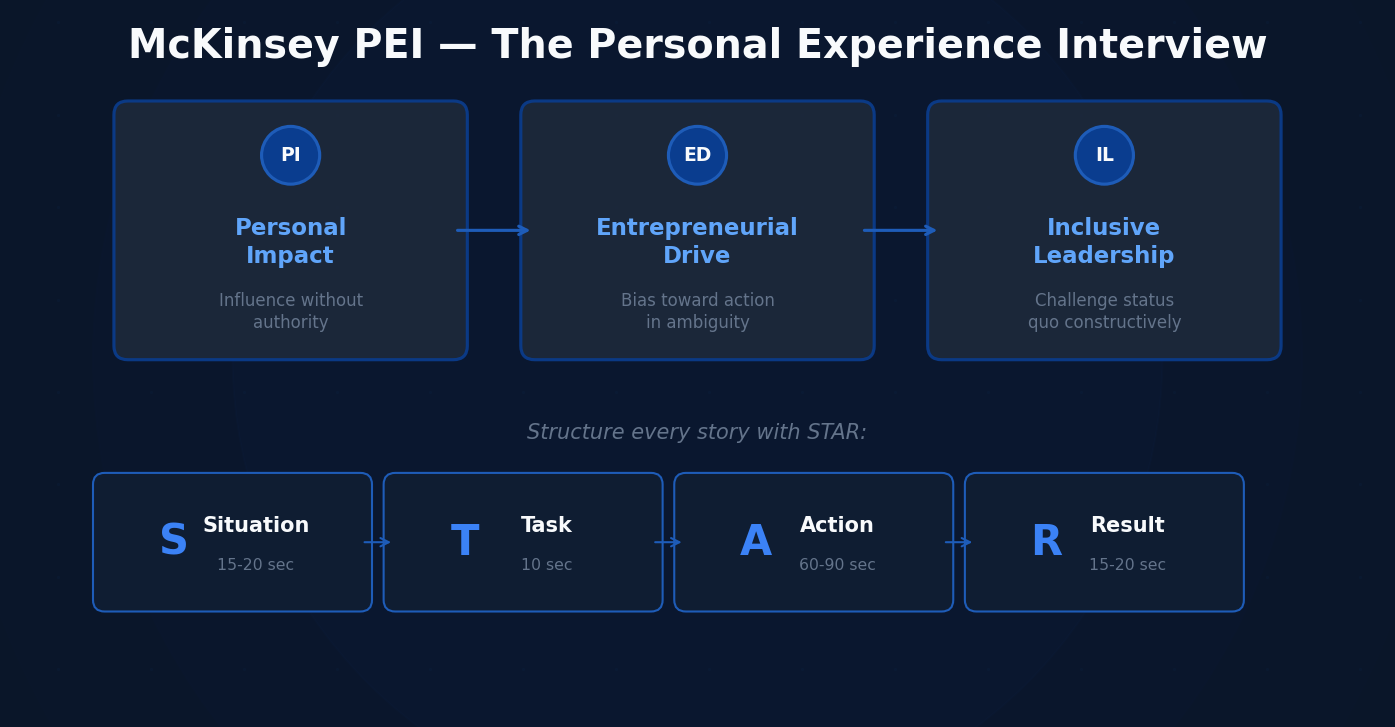
McKinsey evaluates PEI responses across three core dimensions. In a given interview round, each interviewer is typically assigned one dimension to probe:
Personal Impact (Leadership)
This dimension tests your ability to influence others and drive outcomes – especially when you do not have formal authority. McKinsey wants to see that you can persuade, motivate, and move people toward a goal.
What a strong answer demonstrates: You identified a situation where progress required getting others on board. You took specific actions to influence their behavior or decisions. The outcome was meaningfully better because of your involvement.
Common questions: “Tell me about a time you led a team through a difficult situation.” “Describe a time you had to persuade someone who initially disagreed with you.”
Entrepreneurial Drive
This dimension tests your bias toward action in ambiguous, unstructured environments. McKinsey wants to see that you can create momentum from scratch – that you took initiative rather than waiting for direction, showed resourcefulness, and achieved a tangible outcome.
Common questions: “Tell me about a time you accomplished something you are particularly proud of.” “Describe a time you achieved a significant result with limited resources.”
Inclusive Leadership (Courageous Change)
This dimension tests your ability to work across differences and challenge the status quo constructively. The interviewer wants evidence that you recognized an overlooked perspective, took action to broaden the input, and achieved a better outcome as a result.
Common questions: “Tell me about a time you worked with someone very different from you.” “Describe a situation where you challenged a prevailing approach.”
How to Structure Your PEI Stories
The biggest mistake candidates make is rambling. They start at the beginning of a six-month project and narrate every detail chronologically. By minute three, the interviewer has lost the thread and starts checking the clock.
Use a streamlined structure that prioritizes your actions and their impact:
1. Set the Context (15-20 seconds)
Give the interviewer just enough background to understand the stakes. One or two sentences. What was the situation? Why did it matter?
“I was leading a four-person team on a product launch at my company. Two weeks before the deadline, our engineering lead told us the core feature would not be ready on time, which put a $2 million contract at risk.”
2. Describe Your Specific Actions (60-90 seconds)
This is the core of your answer. Walk through what you did, step by step. Be precise. Use “I” not “we.” The interviewer is evaluating you, not your team.
Avoid vague statements like “I communicated with stakeholders.” Instead: “I set up a one-on-one meeting with the engineering lead to understand the technical blockers. Then I proposed a phased delivery plan to the client, prioritizing the three features that addressed their most urgent need.”
3. State the Outcome (15-20 seconds)
Quantify the result if you can. Did revenue increase? Did the project ship on time? Did the team’s engagement improve? If you cannot quantify it, describe the qualitative impact clearly.
“The client accepted the phased plan. We delivered the first release on schedule, retained the contract, and the engineering team delivered the remaining features three weeks later.”
4. Reflect Briefly (10 seconds)
One sentence on what you learned or what you would do differently. This shows self-awareness without turning your answer into a therapy session.
Preparing Your Story Bank
You need three polished stories, one for each dimension. But you should prepare five or six total, because interviewers may follow up with “tell me about a different time” if your first story does not give them enough signal.
For each story, write it out in full first. Then distill it to the structure above. Then practice telling it out loud until it feels natural – not memorized, but confident. You should be able to deliver any story in about two to three minutes.
Draw stories from work experience (strongest for experienced hires), extracurricular leadership, or academic projects with real stakes. Avoid stories where you were a passive participant, the stakes were trivial, or you cannot clearly distinguish your contribution from the team’s.
The Follow-Up Drill-Down
Here is what catches underprepared candidates: the PEI is not a monologue. After your initial story, the interviewer will probe for two to five minutes with follow-up questions designed to test whether the story is real and whether you actually played the role you are claiming.
Expect questions like:
- “Why did you choose that approach specifically?”
- “What was the hardest part of that conversation?”
- “How did the other person react when you pushed back?”
- “What would you have done if they had said no?”
- “Looking back, what would you do differently?”
If you have genuinely lived the experience, these questions are manageable. If you are exaggerating or borrowing someone else’s story, this is where it falls apart. Interviewers are trained to detect rehearsed surface-level answers, and they will keep digging until they hit bedrock.
Common Mistakes
Telling a team story instead of a personal story. Every sentence should make clear what you did. If the interviewer cannot distinguish your contribution from your team’s, the story fails.
Choosing low-stakes examples. “I organized a fundraiser” is fine if the fundraiser involved real conflict, ambiguity, and measurable impact. Otherwise, pick something harder.
Being too humble. This is not the time for modesty. You are not bragging – you are providing evidence of your capabilities. State what you did and what it achieved, plainly and directly.
Over-rehearsing to the point of sounding robotic. Know your stories cold but deliver them conversationally. Vary your phrasing slightly each time you practice so you do not sound like you are reading from a script.
How Caise Helps You Prepare for the PEI
Most PEI preparation happens in your head or on paper. You write out stories, maybe run through them with a friend. The problem is obvious: none of that replicates the pressure of telling your story out loud to an interviewer who is actively probing for weaknesses.
Caise is an AI case interview practice platform built specifically for consulting candidates. While it covers the full case interview – structuring, math, synthesis – its Communication dimension scoring and Socratic interview style make it uniquely effective for PEI preparation.
Communication Scoring That Mirrors PEI Evaluation
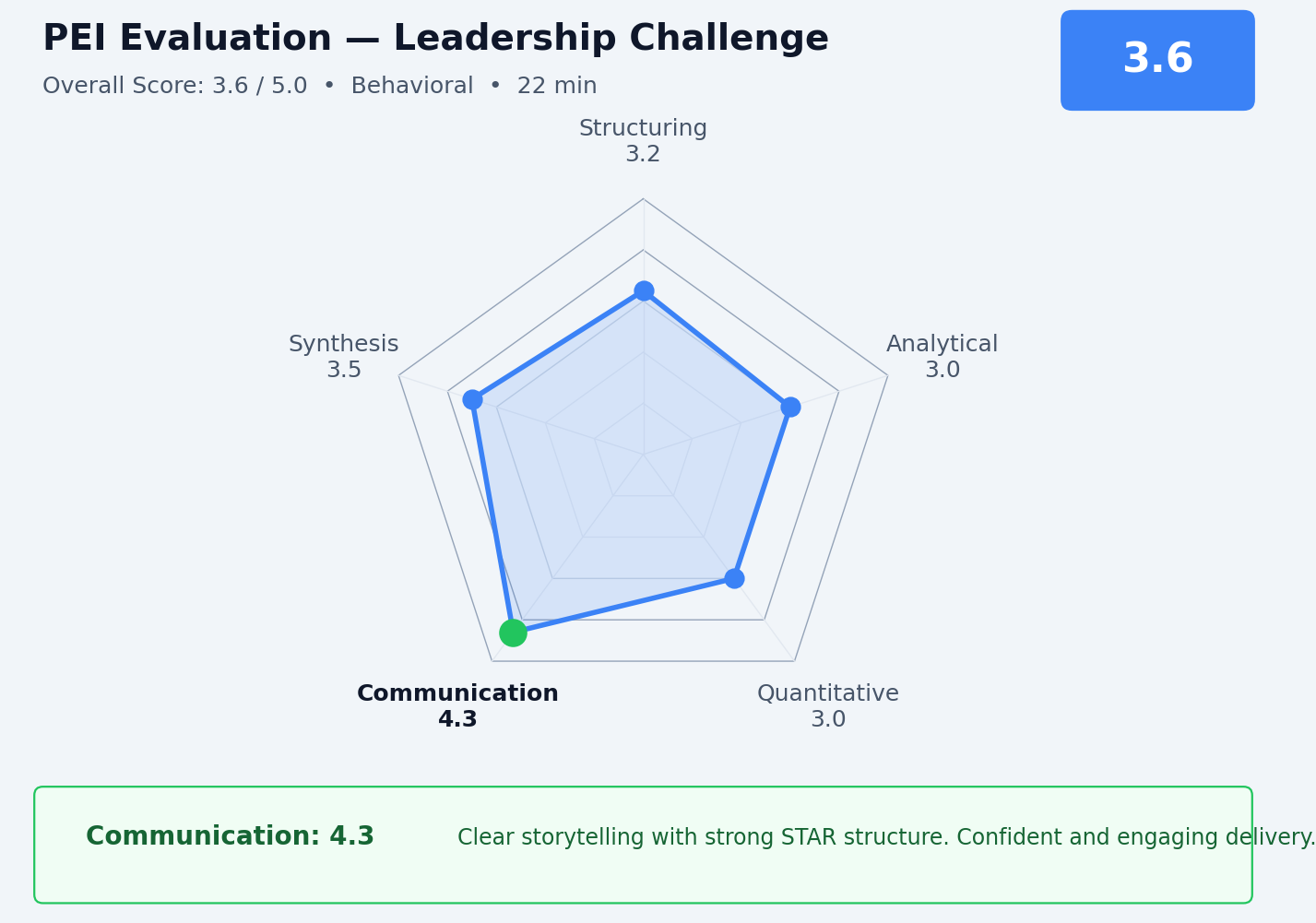
Caise scores every practice session across five dimensions on a 1-5 scale, where a 3 represents the MBB hire bar, a 4 is strong, and a 5 is Distinctive. The Communication dimension specifically evaluates the clarity, specificity, and structure of your responses – exactly the qualities that separate a compelling PEI story from a forgettable one.
After each session, you can see precisely where your storytelling breaks down. Are you providing enough specific detail? Is your narrative structure clear? Are you stating your personal contribution with enough directness? The scoring system surfaces these gaps in a way that practicing alone never will.
Socratic Pushback That Simulates the Drill-Down
The real PEI is not a monologue – it is a conversation where the interviewer keeps digging. Caise’s AI interviewer operates the same way. It pushes back on vague answers, asks pointed follow-up questions, and does not let you get away with surface-level responses.
If you say “I convinced the team to change direction,” the AI will ask how. If you claim an outcome improved, it will ask by how much. This is the same drill-down dynamic described above, and practicing against it repeatedly is the fastest way to develop the reflexive specificity that strong PEI candidates demonstrate.
MBB Exemplar Responses Show You What Distinctive Sounds Like
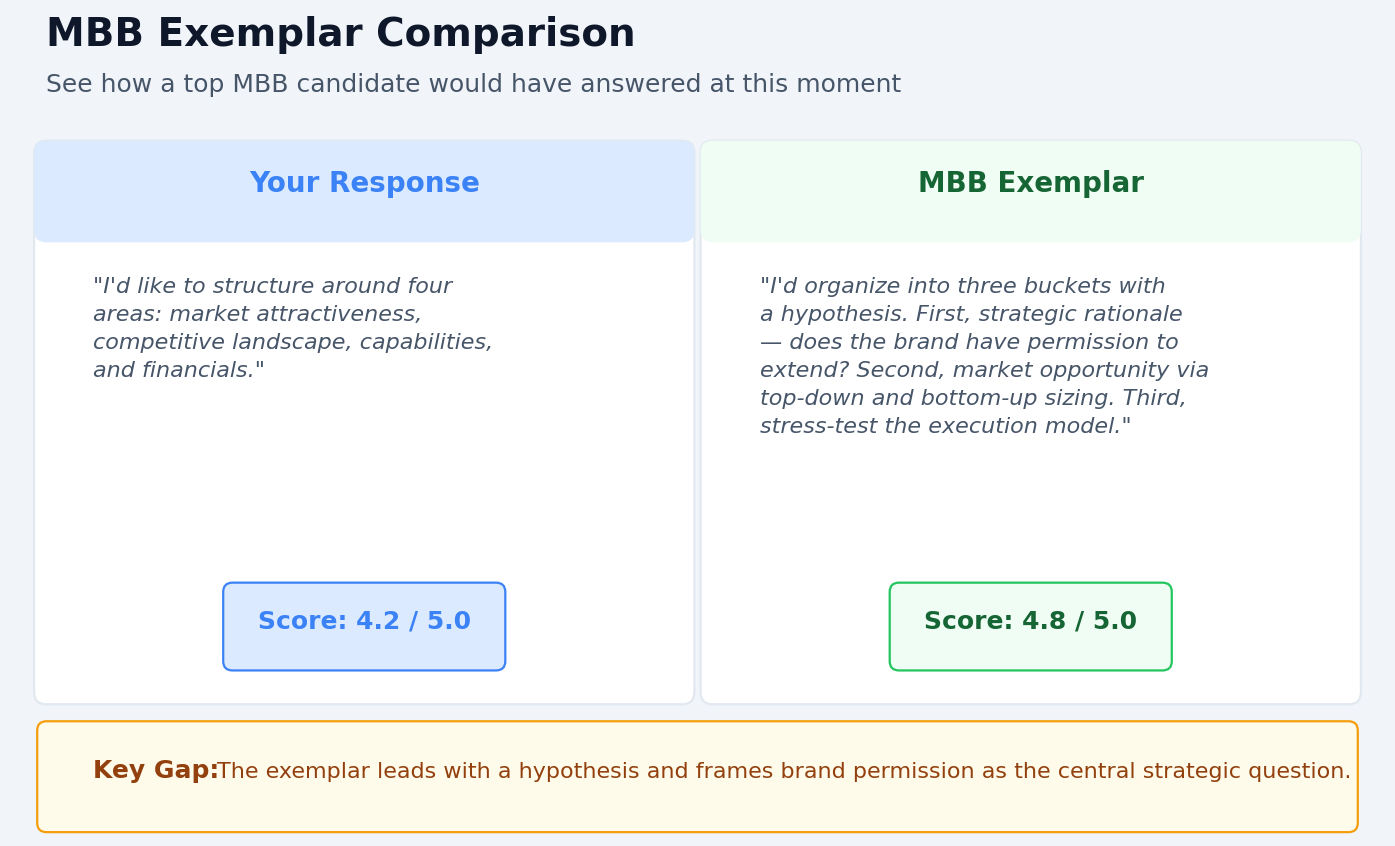
After each practice session, Caise provides MBB Exemplar responses that show exactly what a Distinctive-level candidate would say in the same situation. This gives you a concrete benchmark. Instead of guessing whether your story is “good enough,” you can compare your answer side-by-side with what a top-scoring response actually looks like – the level of detail, the framing, the specificity of actions and outcomes.
Voice-Based Practice Mirrors the Real Experience
Caise runs voice-based interviews where you speak aloud and the AI responds in real time. This matters for PEI preparation because the gap between how a story reads on paper and how it sounds out loud is significant. Stories that seem crisp in your notes often ramble when spoken. Transitions that feel natural in writing come across as stilted. The only way to close this gap is to practice delivering your stories verbally, under the mild pressure of a real-time conversation, over and over.
Putting It All Together
The PEI is a skill, and like any skill, it improves with practice and feedback. Write your stories, pressure-test them with follow-up questions, and rehearse them out loud. If you want structured practice with realistic follow-up probing, Caise can simulate the full PEI dynamic – its Socratic AI interviewer drills into your stories with the same “why did you do that” and “what happened next” follow-ups that McKinsey interviewers use, then scores your Communication on a 1-5 scale so you know exactly where you stand against the MBB hire bar. You can review MBB Exemplar responses after each session to calibrate what a Distinctive answer actually sounds like, and track your scores over time to see whether your storytelling is sharpening or plateauing.
Pair this behavioral preparation with solid case skills – our case structuring guide covers the other half of the McKinsey interview – and you will walk into your interview with both halves of the equation covered.