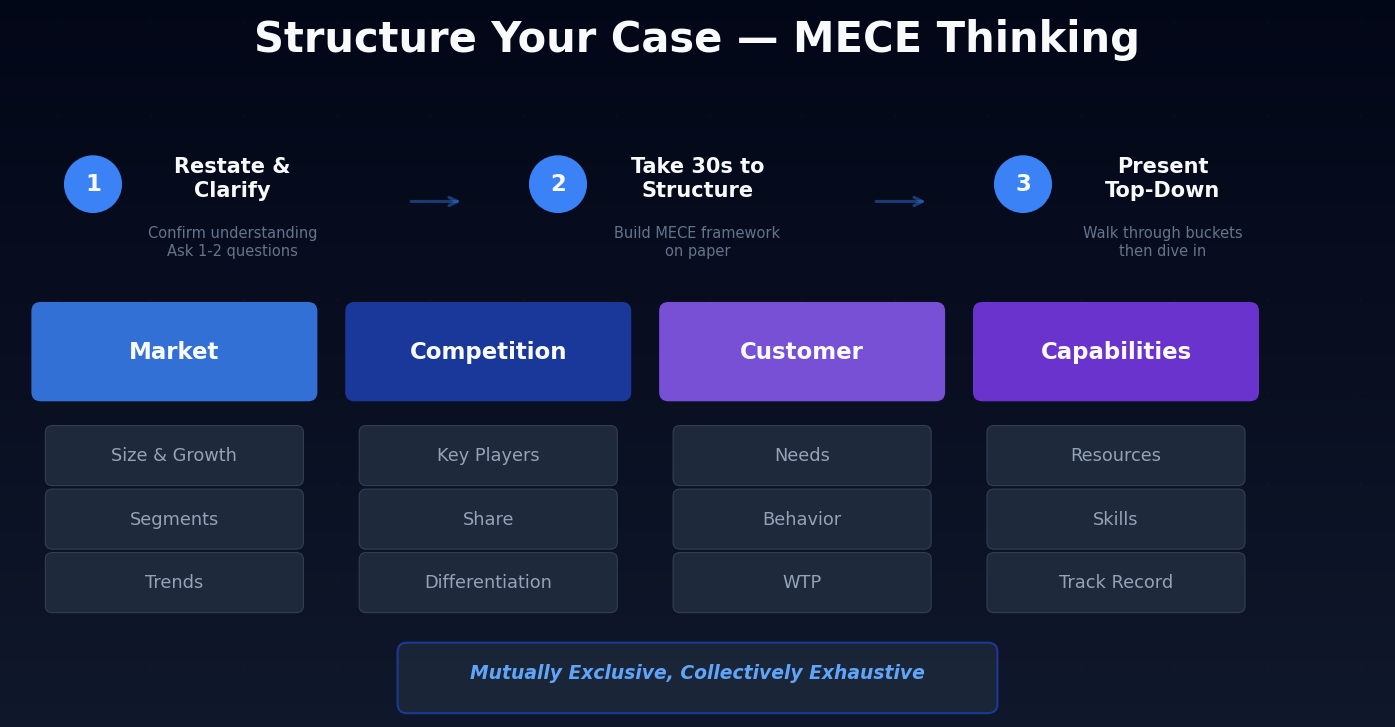
Structuring your approach is the single most important skill in a case interview. Before you crunch a single number or brainstorm a single idea, the interviewer is watching how you organize the problem. A clear structure signals that you can handle ambiguity – the core skill consulting firms are hiring for.
Why Structure Matters More Than the “Right Answer”
Most candidates walk into their first case interview thinking it is a test with a correct answer. It is not. Interviewers at McKinsey, BCG, and Bain evaluate you on how you think, not whether you arrive at a specific conclusion. A candidate who builds a logical, MECE framework and methodically works through it will outperform someone who stumbles onto the right answer through guesswork every time.
MECE stands for Mutually Exclusive, Collectively Exhaustive. It means your categories should not overlap and should cover the full problem space. This is the foundation of every structured approach.
The Three-Step Structuring Process
When the interviewer finishes reading the case prompt, resist the urge to jump in immediately. Instead, follow this process:
1. Restate and Clarify
Paraphrase the problem back to the interviewer in your own words. This does three things: confirms you understood correctly, buys you a moment to think, and shows active listening. Ask one or two clarifying questions if the prompt was ambiguous – but do not ask more than three. The interviewer wants to see you work with incomplete information, not stall for data.
2. Take a Moment to Structure
Say something like: “I’d like to take 30 seconds to organize my thoughts.” Then actually take the time. Write down your framework buckets on paper. Most candidates rush this step because they feel the pressure of silence. The best candidates embrace it. Thirty seconds of silence followed by a crisp structure beats two minutes of rambling every time.
3. Present Your Structure Top-Down
Walk the interviewer through your framework before diving into any single branch. For example:
“I’d like to look at this problem through three lenses: first, the revenue side to understand what’s driving top-line changes; second, the cost structure to identify any margin compression; and third, the competitive landscape to see if external factors are at play. I’d like to start with revenue – does that make sense?”
This gives the interviewer a map of your thinking and invites them to redirect you if needed.
Common Framework Buckets
While you should never memorize and blindly apply a framework, having a toolkit of common buckets helps you build custom structures quickly:
- Profitability: Revenue (price x volume) vs. Costs (fixed vs. variable)
- Market Entry: Market attractiveness, competitive dynamics, company capabilities, entry mode
- Growth Strategy: Organic (new products, new markets, new channels) vs. Inorganic (M&A, partnerships)
- Pricing: Value to customer, cost to serve, competitive pricing, willingness to pay
The key is to adapt these to the specific case. If the case is about a trucking company’s declining profits, your cost structure should mention fuel, labor, and maintenance – not generic “fixed vs. variable.” Specificity shows business intuition.
The Biggest Structuring Mistakes
After reviewing thousands of practice cases, we see the same mistakes repeatedly:
- Using a textbook framework verbatim. Interviewers can spot a memorized framework instantly. It tells them you cannot think independently.
- Too many buckets. Three to four buckets is ideal. More than five means your structure is not synthesized enough.
- Not being MECE. If “marketing effectiveness” and “customer acquisition” are separate buckets, they overlap. Merge them.
- Skipping the structure entirely. Some candidates try to “think out loud” without organizing first. This leads to circular reasoning and missed categories.
How Caise Evaluates Your Structure
Most practice tools give you a pass/fail on your framework. Caise goes deeper. Structuring is one of five dimensions scored on a 1-5 scale, alongside Analytical, Quantitative, Communication, and Synthesis. This matters because structuring is where most candidates either earn the interviewer’s confidence or lose it – within the first two minutes.
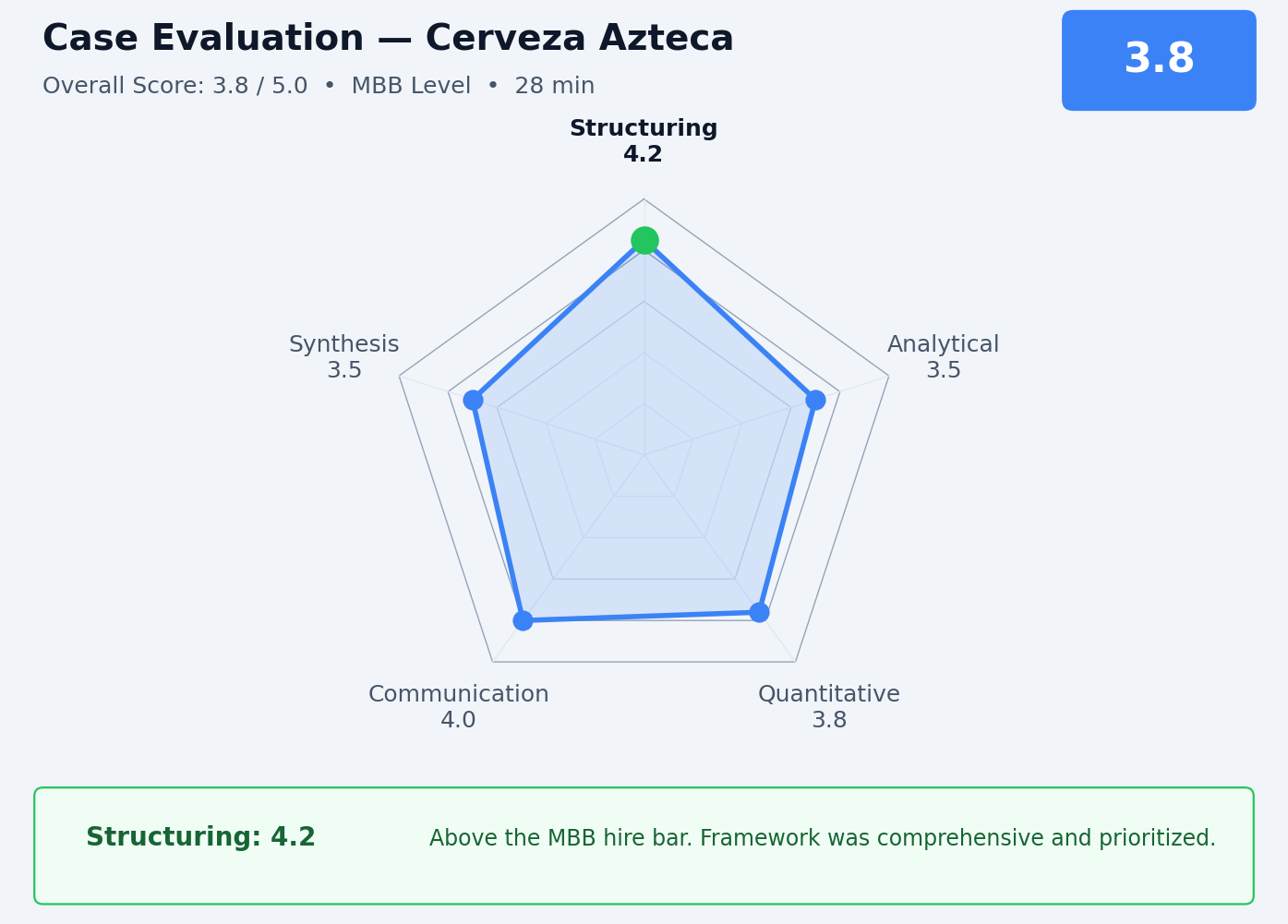
Here is what the scoring ladder looks like for Structuring:
Score 3 (Good – MBB hire bar): Your framework is adequate. You lay out reasonable buckets, handle the data when the interviewer hands it to you, and arrive at a defensible answer – but you need nudging to move between sections and occasionally miss a branch. This is the minimum bar for an offer at McKinsey, BCG, or Bain. Many candidates underestimate how hard it is to consistently hit a 3.
Score 4 (Great – likely advance): Your framework is MECE and tailored to the specific case, not a recycled textbook structure. You prioritize which bucket to explore first and explain why. You move between sections without being prompted and synthesize findings as you go.
Score 5 (Distinctive): You build a genuinely MECE framework customized to the industry and case prompt. You proactively synthesize after each section, tying findings back to the original question. You demonstrate strong business judgment – knowing which levers matter most and why. At this level, the interviewer is learning from your analysis, not guiding it.
Caise’s AI interviewer flags MECE violations in real time. If your “cost reduction” bucket overlaps with your “operational efficiency” bucket, you will hear about it immediately – the same way a McKinsey interviewer would push back with “How are those two different?” This Socratic pushback forces you to sharpen your thinking on the spot, not after the fact.
After every case, the MBB Exemplar feature shows you exactly what a top candidate’s structure would look like for that same prompt. You see their buckets, their prioritization logic, and how they framed the problem. Comparing your framework side-by-side with an exemplar response is the fastest way to close the gap between a 3 and a 5.
Because Caise tracks your scores across every case you complete, you can watch your Structuring score improve over time. Most candidates see the biggest jumps in their first 10-15 cases – once the pattern of building custom, MECE frameworks becomes instinct rather than effort.
How AI Practice Helps
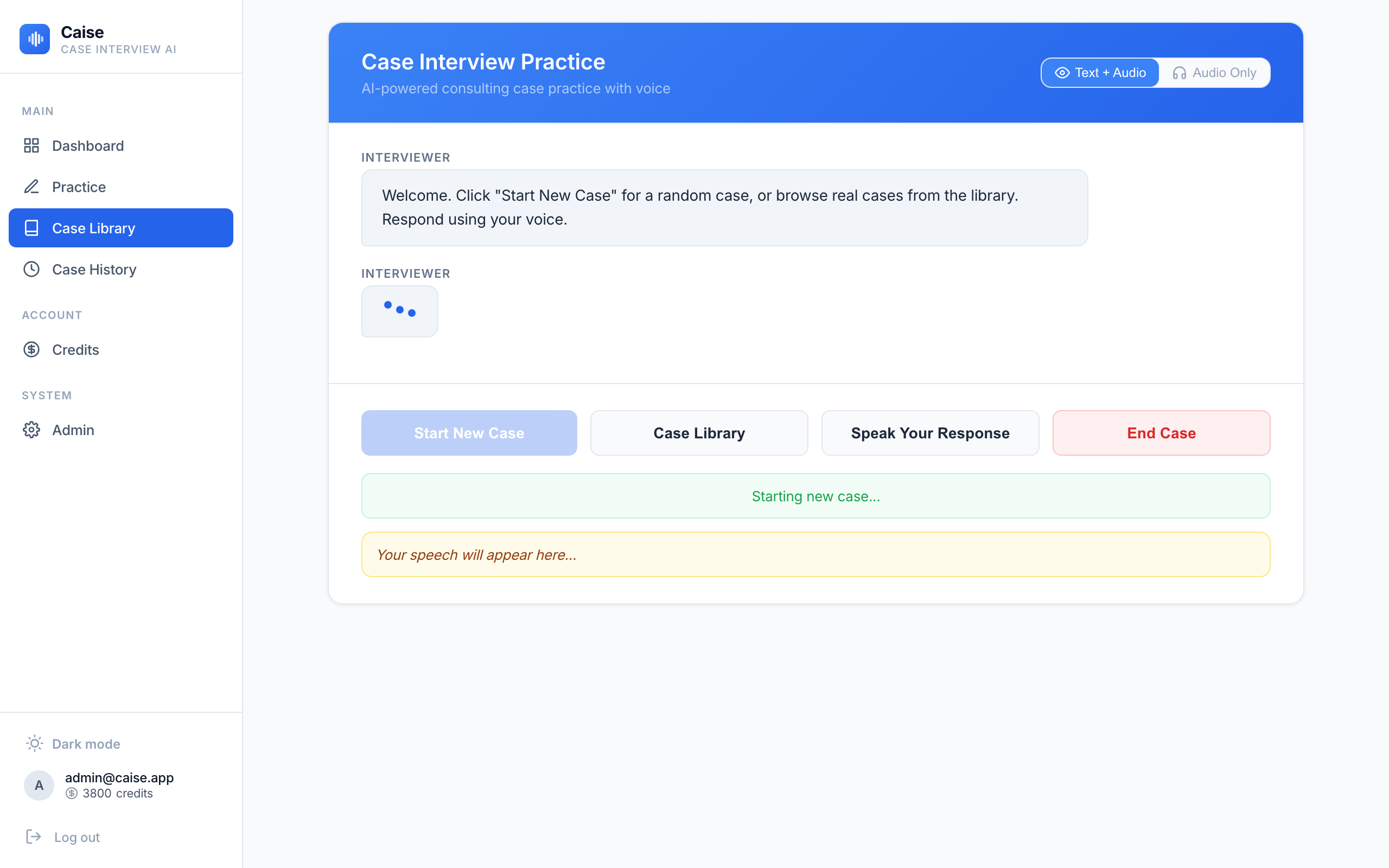
One challenge with structuring is that you need real-time feedback. A study partner might not catch that your framework overlaps, or they might not push back on a weak bucket the way a real interviewer would. Caise solves this with voice-based practice that mirrors a real interview. You speak your structure out loud, and the AI interviewer responds conversationally – asking follow-up questions, challenging weak logic, and redirecting you when your framework has gaps. There is no typing, no multiple-choice buttons. It is a live conversation, the same way your McKinsey interview will be.
During the case, Caise shares interactive handouts and exhibits just like a real interviewer slides a chart across the table. You receive data tables, graphs, and market information that you need to interpret and integrate into your analysis. This trains the skill that most self-study misses entirely: building your structure while processing new information under time pressure.
The real-time pushback is what separates Caise from practicing with a friend or reading case books. When you say something vague like “I’d look at the market,” Caise asks “Why? What specifically about the market is relevant here?” It does not let you coast through weak reasoning. With 60+ real MBB and HBS cases, you get enough variety that you cannot fall back on memorized structures – you have to build fresh frameworks every time.
The best way to improve is to practice structuring a wide variety of cases until it becomes second nature. Structure is a muscle. The more you exercise it, the faster and cleaner your frameworks become on interview day.
Ready to see where your structuring skills actually stand? Start a free case and get scored across all 5 dimensions – Structuring, Analytical, Quantitative, Communication, and Synthesis. See your scores, compare against MBB exemplar responses, and track your improvement over time.