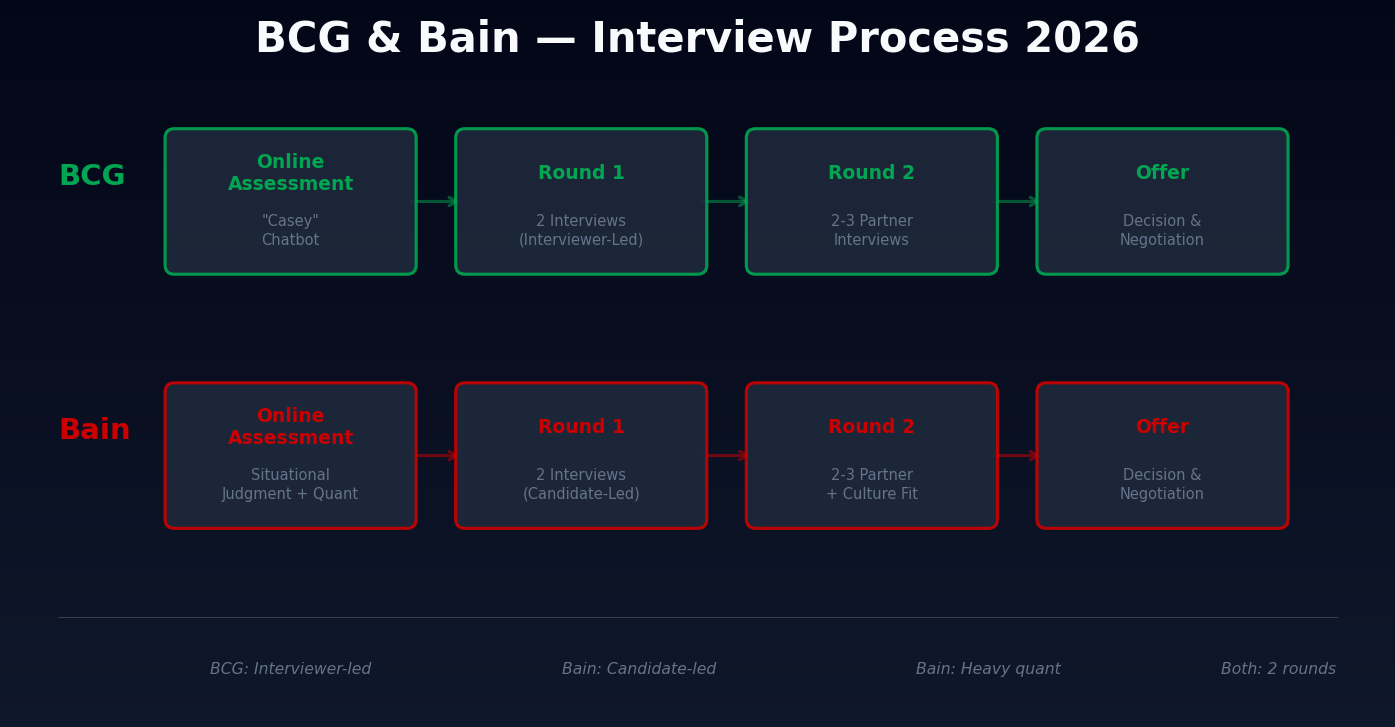
If you are interviewing at BCG or Bain in 2026, you are entering a process that has evolved over the past few years. The core remains the same – a case discussion plus a behavioral assessment – but the formats and screening tools have been updated. This guide breaks down what to expect at each firm.
BCG Interview Process
BCG’s interview process typically consists of two rounds, with a possible third round for certain offices or if the interviewers from earlier rounds want additional signal.
Round 1: First-Round Cases (2 interviews)
Each Round 1 interview is approximately 40 to 45 minutes and includes two components:
The case (25-30 minutes). BCG cases tend to be interviewer-led, meaning the interviewer guides you through a series of questions rather than handing you an open-ended prompt and letting you drive. You might be asked to structure a problem, then directed to analyze a specific data exhibit, then asked to do a calculation, and finally asked for a recommendation.
This does not mean you are passive. You still need to demonstrate structured thinking, ask smart clarifying questions, and show business judgment. But the interviewer maintains more control over the flow compared to a candidate-led McKinsey case.
The fit portion (10-15 minutes). BCG calls this the “behavioral” interview. Expect questions about your resume, your motivations for consulting, and one or two behavioral questions. BCG interviewers often weave fit questions into the case itself, so be ready for the line between “case” and “fit” to blur.
The BCG Casey Chatbot (Online Case)
Many BCG offices now include an online case assessment as part of the screening process, often before Round 1. This is BCG’s proprietary chatbot-based case called “Casey.” You interact with a text-based chatbot that presents a business scenario and asks you a series of structured questions – some multiple choice, some requiring you to type short answers or perform calculations.
Casey is timed, with questions that escalate in complexity from basic business sense to quantitative reasoning. There is no interviewer to ask clarifying questions – you work with the information provided. It is a screening filter, not a replacement for live interviews. Practicing structured cases with clear question-by-question progression – similar to tools like Caise – helps the chatbot format feel familiar.
Round 2: Final-Round Cases (2-3 interviews)
If you pass Round 1, the final round consists of two to three interviews with Partners or Managing Directors. The cases are harder – more ambiguous prompts, more complex data exhibits, and higher expectations for business judgment. Interviewers are also evaluating whether they would put you in front of a client, so communication quality matters more at this stage.
BCG evaluates across five dimensions: problem structuring, analytical rigor, business judgment, communication, and creativity. The exact rubric varies by office, but these are consistent across the firm.
Bain Interview Process
Bain’s process is similar in structure to BCG’s but has its own distinct characteristics, particularly around culture fit and the “Bain way.”
Round 1: First-Round Cases (2 interviews)
Each Round 1 interview at Bain runs about 30 to 40 minutes. Bain cases are more candidate-led than BCG’s – you are expected to lay out a structure, choose where to investigate first, and ask for data. Bain places a strong emphasis on quantitative analysis. Expect significant math in at least one case: market sizing, break-even analysis, or capacity calculations.
The fit portion at Bain focuses heavily on culture fit. Bain places particular emphasis on what they call “a Bainie” – collaborative, high-energy, results-oriented. Expect questions like:
- “Why Bain specifically, and not McKinsey or BCG?”
- “Tell me about a time you worked on a team where things were not going well. What did you do?”
- “What would your teammates say about working with you?”
Bain interviewers genuinely care about whether you would be a good colleague. Candidates with strong case performance but weak culture fit do get rejected.
The Bain Online Assessment
Bain uses online tests as a screening tool: situational judgment scenarios, quantitative reasoning problems, and a short written case analysis. The assessment is timed, completed remotely, and used to narrow the applicant pool before first-round interviews.
Round 2: Final-Round Cases (2-3 interviews)
Bain’s final round mirrors its first round but with more senior interviewers and harder cases. Some offices include a conversational “partner case” where the interviewer describes a client situation in broad terms and asks “how would you think about this?” – testing your ability to impose structure on genuine ambiguity.
Bain evaluates on problem-solving, results delivery, leadership, passion for Bain, and teamwork orientation.
Key Differences Between BCG and Bain Interviews
| Aspect | BCG | Bain |
|---|---|---|
| Case format | More interviewer-led | More candidate-led |
| Online screening | Casey chatbot case | Multi-component assessment |
| Math emphasis | Moderate | Heavy |
| Culture fit weight | Important | Very important |
| Case style | Structured, exhibit-heavy | Quantitative, open-ended |
| Partner round | Similar to earlier rounds | More conversational |
What Has Changed in 2026
A few notable trends affecting both firms this year:
Expanded online screening. Both firms have expanded pre-interview assessments. Prepare for online components as seriously as live cases.
Heavier data interpretation. Expect more complex exhibits – multi-tab spreadsheets, ambiguous charts, and data with intentional noise. Identifying signal in messy data is now a more prominent evaluation criterion.
New case topics. Cases involving digital transformation, AI strategy, and sustainability have become more common. Our profitability case guide remains essential, but supplement it with newer sectors.
Virtual interviews persist. Virtual first rounds remain common, especially across geographies. Ensure your setup is professional and you are comfortable presenting case work over video.
Preparation Advice for Both Firms
Regardless of which firm you are targeting, three things matter most:
-
Practice the right format. If you are interviewing at BCG, drill interviewer-led cases. If you are interviewing at Bain, practice driving a case from start to finish. These are different skills. Our structuring guide covers the fundamentals that apply to both formats.
-
Do not neglect fit. Candidates routinely underprepare for the behavioral portion. At Bain especially, culture fit can make or break your candidacy. Prepare three to four strong stories and be ready to discuss them with specificity and self-awareness. Our McKinsey PEI guide covers story preparation techniques that apply across all three MBB firms.
-
Simulate interview pressure. Knowing how to solve a case at your desk is different from performing under time pressure with someone watching. Caise is built specifically for this – it runs voice-based case interviews where you speak aloud and the AI interviewer responds in real time, pushing back on vague answers and asking follow-up questions just like a real BCG or Bain interviewer would. After each case, you get scored across five dimensions on a 1-5 scale (where 3 is the MBB hire bar), so you can track exactly where you stand. Whether you use Caise, a human partner, or a study group, make sure you are practicing under conditions that approximate the real thing.
How to Practice for BCG and Bain with Caise
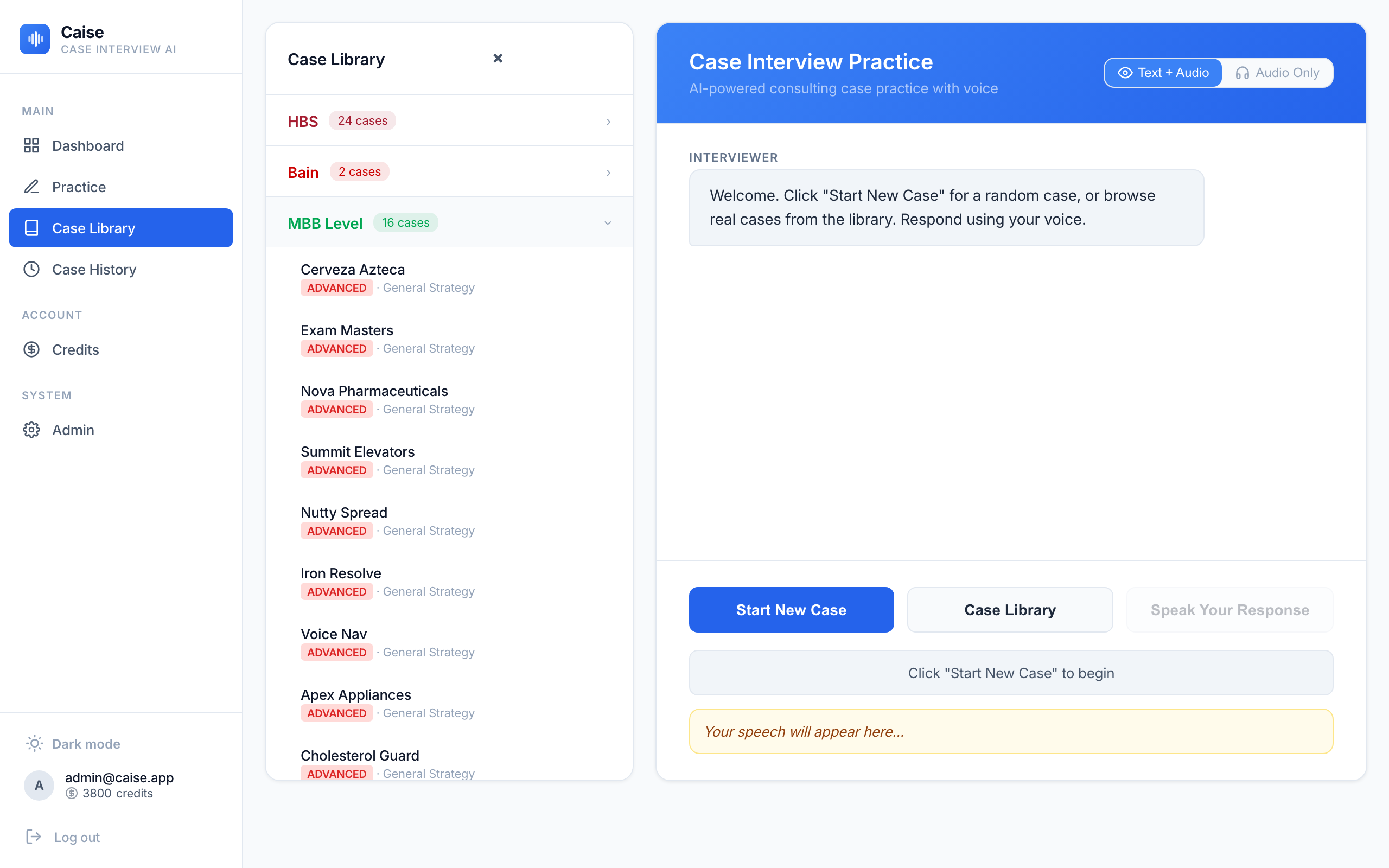
If you are preparing for BCG, Bain, or both, Caise lets you practice both interview formats in one platform. The 60+ case library includes interviewer-led cases that mirror the BCG format – where the AI guides you through structured questions, data exhibits, and calculations in sequence – and candidate-led cases that mirror the Bain format, where you drive the structure, choose where to dig in, and request data on your own. Practicing both styles is essential if you are applying to multiple firms, and most candidates are.
Scoring That Maps to What BCG and Bain Actually Evaluate
Caise scores every case across five dimensions: Structuring, Analytical, Quantitative, Communication, and Synthesis. Each dimension is scored on a 1-5 scale, where 3 represents the MBB hire bar (adequate performance for an offer), 4 is strong, and 5 is Distinctive.
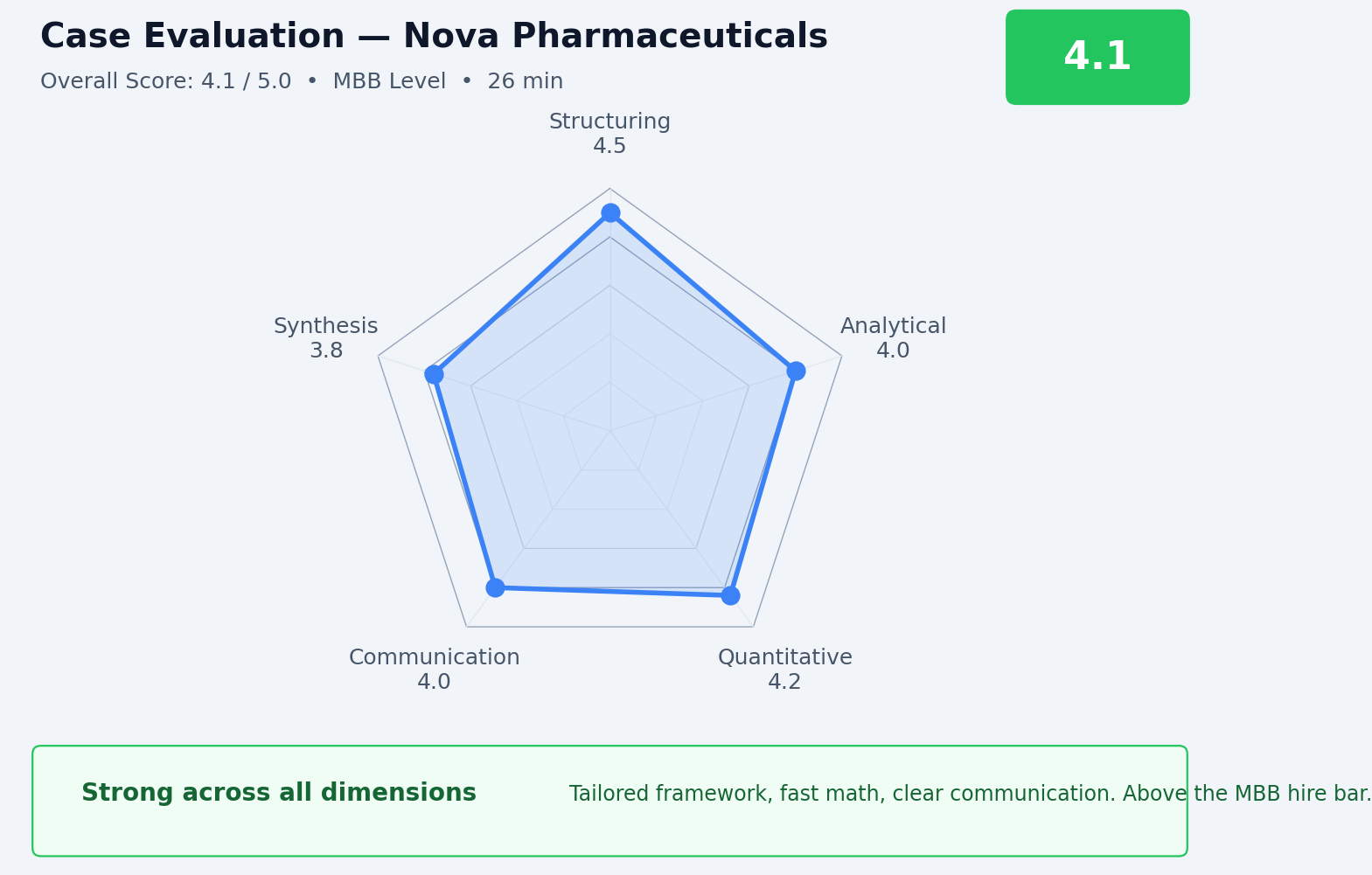
These five dimensions map directly to what both firms evaluate. BCG’s rubric emphasizes problem structuring, analytical rigor, business judgment, communication, and creativity – Caise’s Structuring, Analytical, and Communication scores give you direct feedback on three of those five. Bain’s rubric emphasizes problem-solving, results delivery, leadership, passion, and teamwork – the Quantitative and Synthesis scores tell you whether your math is sharp enough and whether your recommendations are actionable, which are the two areas where Bain candidates most often fall short.
After every case, you can see exactly which dimensions pulled your score down and compare your responses to MBB Exemplar answers that show what a Distinctive candidate would say. The Exemplars cover both interviewer-led and candidate-led formats, so you can see the difference between a strong BCG-style response (concise, structured, exhibit-driven) and a strong Bain-style response (hypothesis-driven, quantitatively rigorous, recommendation-oriented).
Data Interpretation Practice with Interactive Exhibits
Both BCG and Bain have increased the complexity of data exhibits in 2026. Caise cases include interactive handouts and exhibits that surface during the interview when you ask the right questions – just like in a real case. This trains the skill of identifying what data you need, requesting it clearly, and interpreting charts and tables under time pressure. For BCG-style interviewer-led cases, the exhibits appear when the interviewer directs you to them. For Bain-style candidate-led cases, you need to ask for the data yourself, which is a fundamentally different skill.
Voice-Based Practice Under Pressure
Reading a case framework on a slide is not the same as articulating it aloud while an interviewer watches you. Caise runs entirely on voice – you speak your structure, talk through your math, and deliver your recommendation out loud. The AI interviewer responds in real time and will push back on weak logic, ask “why?” when your reasoning is thin, and redirect you if you go off track. This is the closest simulation of the pressure you will feel in a live BCG or Bain interview, whether virtual or in-person.
After the case, the post-case debrief lets you ask the AI coach follow-up questions: “What should I have done differently in my structure?” or “Was my math approach the most efficient?” This turns every practice case into a learning opportunity, not just a pass/fail exercise.
Math Drills for Bain’s Quantitative Emphasis
Bain cases are quantitatively heavier than BCG’s. If mental math is a weakness, Caise includes 10 dedicated math drills covering percentage changes, breakeven analysis, weighted averages, and other calculation types that appear frequently in Bain cases. These drills are timed and designed to build speed and accuracy – the two things that separate candidates who fumble through calculations from those who handle them cleanly and move on to the insight.
Building a Practice Routine
The most effective preparation combines format-specific case practice, math drills, and regular scoring review. A realistic weekly schedule might look like this:
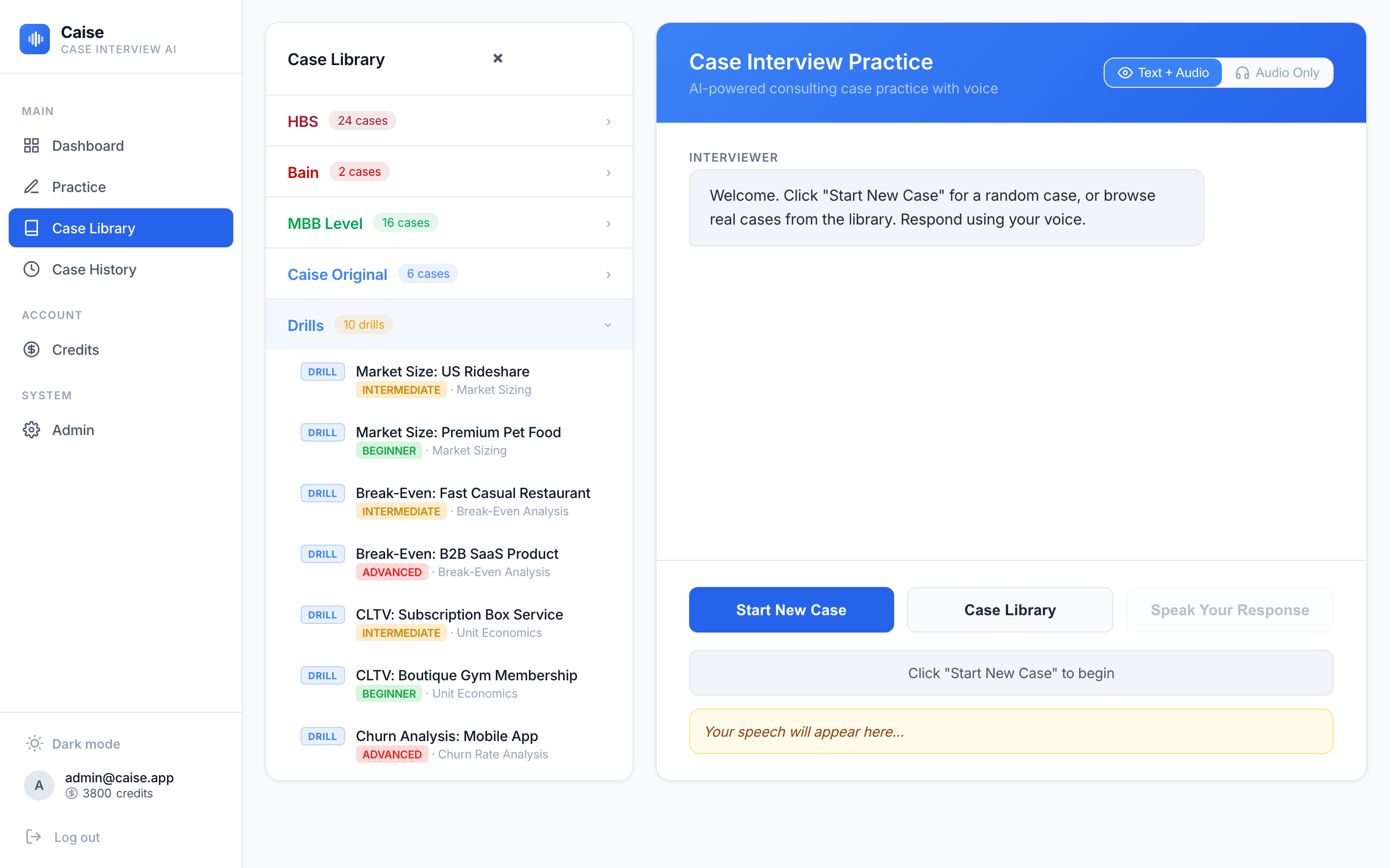
Track your scores over time to identify patterns. If your Structuring score is consistently a 4 but your Quantitative score hovers at 2, you know exactly where to focus. Caise’s score tracking and coaching insights surface these patterns automatically, so you spend your limited preparation time on the areas that will actually move the needle.
Both processes are rigorous but predictable. Understand the format, practice systematically, and prepare for both dimensions, and you will walk in with a significant advantage.